
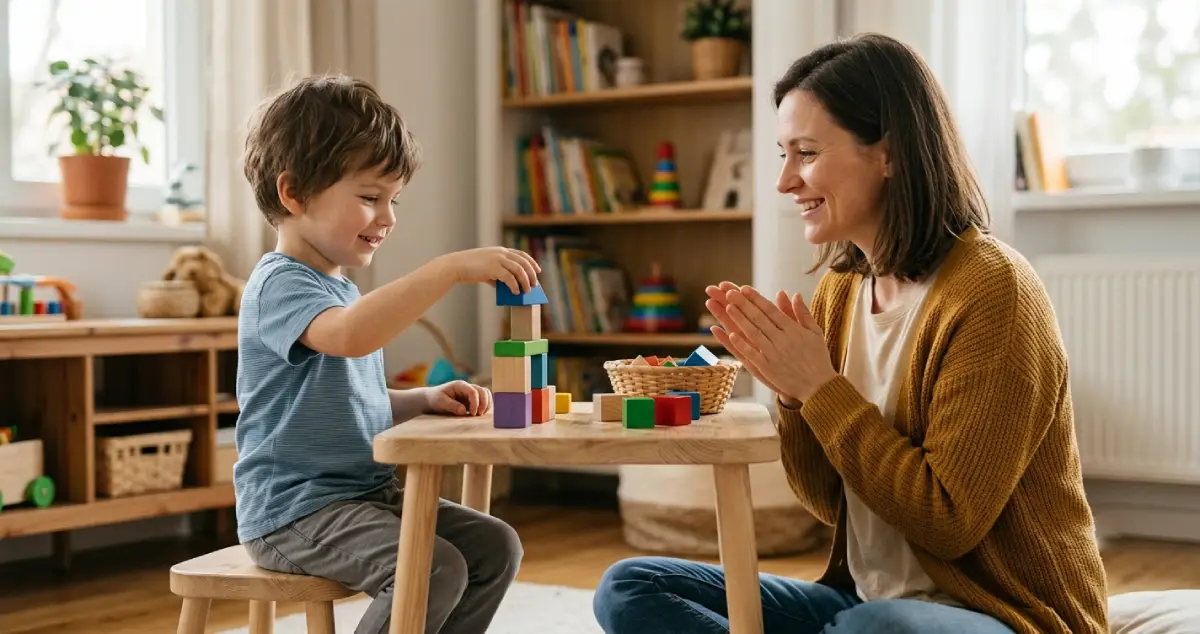
If your child refuses to share their toys, gets upset when waiting their turn, interrupts play, always wants to go first, or often ends up in arguments with siblings and friends, you might feel like the problem is about “manners” or “personality.”
You might find yourself saying things like:
“Share with your brother.”
“Wait your turn.”
“Don’t be selfish.”
“Play nicely with everyone.”
“Don’t get angry when you lose.”
But the same behavior keeps happening again.
At this point, we need to look at things a bit deeper.
Teaching a child to share and take turns doesn’t happen through lectures alone. Sharing, taking turns, accepting losing, asking for a turn, respecting others’ boundaries, and playing with others… these are all social skills that need to be trained step by step, just like reading and writing.
This article will help you understand why sharing and waiting for a turn can be difficult for some children, and it will also give you practical steps and simple home games that build social skills without stress or shouting.
Small note: choose your child’s age inside the box page.
Quick takeaway for busy moms
If you don’t have time to read the full article right now, here’s the main idea:
- A child who doesn’t share their toys is not necessarily a selfish child.
- And a child who doesn’t wait for their turn isn’t always disrespectful.
In many cases, the child simply hasn’t practiced the skill yet, such as:
- How to ask for a turn
- How to wait patiently
- How to accept that a toy isn’t only theirs
- How to say “no” in a kind way
- How to deal with losing
- How to join play without taking over
- How to disagree without shouting or hitting
Start with these simple rules:
- Don’t begin with their favorite game.
- Keep turn-taking short and clear.
- Use only one social phrase at a time.
- Praise waiting and sharing, not just winning.
- Practice the skill when things are calm, not only during conflicts.
- Use short games instead of long lectures.
- Don’t label the child as “selfish”; describe the behavior and teach an alternative.
The goal:
- Not to raise a perfectly social child
- But to help them learn one small step at a time
What are social skills in children?
Social skills are the way a child interacts with others during play, conversation, sharing, conflict, waiting, and cooperation.
They include:
- Sharing toys
- Waiting for a turn
- Asking politely
- Saying “no” without aggression
- Accepting losing
- Congratulating others when they win
- Playing by rules
- Listening to others
- Not interrupting
- Understanding others’ feelings
- Apologizing and making things right
- Joining group play
- Leaving conflicts safely
These skills don’t appear suddenly.
A child needs to see them, hear them, try them, make mistakes, and practice them again and again.
Why does a child refuse to share?
Refusing to share can have many reasons. It doesn’t always mean the child is trying to upset others.
1. They feel the toy belongs to them completely
Young children often see their favorite toy as part of their personal world.
When asked to share, they may feel threatened rather than generous.
They are not always thinking:
“I should be kind and share.”
They may think:
- “They will take my toy.”
- “They won’t give it back.”
- “They might break it.”
- “I want it right now.”
That’s why we shouldn’t start sharing practice with their most valued toy. We start with something easier.
2. They don’t understand “turn-taking”
“Wait your turn” sounds clear to adults, but not always to children.
A child needs to see turns in a concrete way:
- “My turn”
- “Your turn”
- “After the timer”
- “After 10 seconds”
- “After your brother plays once”
The more visible and structured the turn is, the easier waiting becomes.
3. They struggle with waiting
Some children understand the rule but cannot tolerate waiting.
This is more common in children with high energy, impulsivity, or difficulty regulating emotions.
They may think internally:
“I can’t wait, I want it now.”
In this case, waiting must be trained as a skill, not just repeated as an instruction.
4. They are afraid of losing
Sometimes the child is not refusing to share, but refusing the possibility of losing.
If every game feels like winning or losing, play becomes stressful.
They may get upset because:
- They don’t like losing
- They feel “less than” others
- They fear being laughed at
- They don’t know how to say “it’s okay”
- They try to control the situation to avoid frustration
That’s why “safe losing” should be practiced at home.
5. They don’t know the right social phrases
Some children get into conflict simply because they don’t know what to say.
1.Instead of:
“Can I play with you?”
they grab the toy.
2.Instead of:
“My turn after you.”
they push or shout.
3.Instead of:
“I don’t want to now.”
they run away or get angry.
So instead of only correcting behavior, we need to teach the right phrases and repeat them in small situations.
6. The environment increases tension
Group play becomes harder when the environment is chaotic or unclear.
For example:
- Too many children want the same toy
- No clear turn-taking rules
- The game takes too long
- The child is hungry or tired
- Adults intervene by shouting
- The child is suddenly forced to share a favorite toy
All of these factors make sharing much more difficult.
Is lack of sharing normal depending on age?
Yes, to a certain extent.
Sharing and turn-taking are skills that develop gradually. We cannot expect a young child to share at the same level as an older child.
Age 2–3 years
At this age, sharing is usually very difficult.
The child may mostly play alongside other children rather than with them.
They may say:
- “Mine.”
- “Me.”
- “No.”
This does not mean they will stay selfish.
They are simply still learning that other people also have needs and wants.
Age 4–5 years
At this stage, children begin to understand turn-taking and sharing better, but they don’t always apply it—especially with favorite toys or when they are tired.
They can be trained through:
- Short turns
- Simple turn-taking games
- Basic social phrases
- Sharing less-preferred items first
Age 6–9 years
Here we expect a clearer understanding of social rules:
- Waiting for their turn more often
- Participating in short group games
- Gradually understanding winning and losing
- Learning to apologize
- Saying things like “my turn after you”
However, children with impulsivity or difficulty regulating emotions may still need extra practice.
Age 10–13 years
At this stage, social skills become more complex.
The challenge is no longer just sharing toys, but:
- Joining groups
- Accepting different opinions
- Handling teasing
- Understanding personal boundaries
- Working on group projects
- Managing conflicts
- Not controlling conversations or play
Here, children need more mature discussion, role-play, and age-appropriate social scripts.
When should we worry about social difficulties?
We don’t worry about a single incident or a bad day. &We look at repetition and impact.
&We may need a clearer plan if the child:
- Refuses to share consistently
- Cannot wait at all
- Has daily conflicts with siblings
- Gets extremely angry when losing
- Frequently takes others’ belongings
- Constantly interrupts play or conversation
- Struggles to join group play
- Always withdraws from other children
- Prefers to play alone with noticeable distress
- Is repeatedly rejected by peers
- Uses hitting or pushing instead of talking
- Does not improve with simple guidance
- Shows difficulties at both home and school
If social difficulties are severe, or combined with language delays, strong anxiety, high impulsivity, or persistent isolation, it is better to consult a specialist.
The difference between “a selfish child” and “a child who needs skill training”
Describing a child as “selfish” can hurt them and doesn’t give them a way to change.
Instead of saying:
- “You are selfish.”
- “You don’t love anyone.”
- “You don’t know how to play.”
We say:
- “We need to practice sharing.”
- “Waiting was difficult for you.”
- “You really wanted the toy quickly.”
- “Let’s learn the phrase: my turn after you.”
- “We are practicing turn-taking.”
Language matters a lot.
When we label a child with a fixed trait, they feel the problem is part of who they are.
When we describe it as a skill, they feel it can be learned.
Steps to teach sharing and turn-taking
Step 1: Start with something easy, not the favorite toy
Don’t begin with the child’s most loved toy.
If they really love a specific car, don’t use it first for training sharing.
Start with something less sensitive:
- Blocks
- Pens
- Cards
- Small balls
- Stickers
- Simple toys
- Drawing tools
The goal is early success, then gradually move to harder items.
Step 2: Keep turns short and clear
Children cannot tolerate long waiting at the beginning.
Start with short turns:
- “My turn for 10 seconds, then your turn.”
- “You play once, I play once.”
- “We take turns throwing the block.”
- “We pick cards alternately.”
Use a timer or simple counting.
The clearer the turn, the less anxiety.
Step 3: Use consistent words
Choose a few simple phrases and repeat them:
- My turn
- Your turn
- We wait
- After you
- Can I?
- Here you go
- Thank you
- It’s okay
- Again
Don’t overload the child with many phrases at once.
Start with just one sentence.
Example for a full week:
- “My turn after you.”
Repeat it in daily play until it becomes natural.
Step 4: Praise the skill, not just winning
If we only praise winning, the child will fear losing more.
Praise:
- Waiting
- Taking turns
- Asking politely
- Accepting “no”
- Congratulating others
- Returning to play after anger
- Using social phrases
- Sharing one item
Say things like:
- “I like how you waited.”
- “Great job saying ‘my turn after you.’”
- “I liked how you gave your brother a turn.”
- “That is called sharing.”
- “You lost calmly—that’s strong practice.”
Step 5: Practice safe losing
Don’t wait for a big emotional moment to teach losing.
Use very short games (1–2 minutes).
Before starting, say:
- “Today our goal is not to win. Our goal is to practice what we say when we lose.”
Teach the phrase:
- “It’s okay, let’s try again.”
After the game, even if the child gets upset a little, praise any attempt:
- “I liked that you came back to play.”
- “Good job trying to say ‘it’s okay.’”
- “Next time will be easier.”
Step 6: Teach how to ask to join play
Some children enter play in ways that make others reject them.
Teach simple phrases:
- “Can I play with you?”
- “Is it my turn?”
- “What are you playing?”
- “Can I help?”
- “Can I pick a card?”
Role-play these situations at home before real-life situations.
Step 7: Teach how to refuse politely
Social skills are not only about sharing.
Children also need to know how to say “no” without aggression.
Useful phrases:
- “Not right now.”
- “Maybe later.”
- “This is my favorite toy, I’ll share another one.”
- “I don’t like this game, can we choose something else?”
This is important because forcing a child to share everything can increase resistance.
We want balance:
Sometimes they share, and sometimes they protect their boundaries in a healthy way.
10-Day Plan to Build Sharing and Turn-Taking Skills
Day 1: Observe the main conflict
Write down:
- Is the problem sharing?
- Turn-taking?
- Losing?
- Joining play?
- Interrupting?
- Taking things?
Choose only ONE skill to start with.
Day 2: Choose an easy game
Use a simple game that is not the child’s favorite.
Examples:
- Cards
- Blocks
- Pens
- Throwing a ball
- Building pieces
- Short memory games
Day 3: Practice “my turn / your turn”
Play with him for only 2 minutes.
Say:
- “My turn.”
Then: - “Your turn.”
Don’t ask for anything more than that.
Day 4: Add one social phrase
Choose one phrase:
- “My turn after you.”
- “Can I?”
- “Here you go.”
Repeat it during play.
Day 5: Use a turn timer
Make turns 10 seconds, one throw, or one card.
The child needs to see that waiting has an end.
Day 6: Praise waiting
Focus only on praising waiting:
- “I liked how you waited.”
- “You waited until I said your turn.”
- “That was excellent waiting.”
Day 7: Practice safe losing
Choose a quick game.
Before starting, say:
- “If we lose, we say: it’s okay, let’s try again.”
Keep the game short.
Day 8: Add another child or sibling
If things go well, add a sibling or another child for a short time.
Start with only 5 minutes.
Don’t wait until the children get tired and things escalate.
Day 9: Review what worked
Ask yourself:
- Did they wait more?
- Did they share something small?
- Did they use the phrase?
- Did shouting decrease?
- Could they recover after conflict?
- Did they accept small losses?
Day 10: Consolidate the skill
Repeat the same game and the same phrase for several days.
Don’t rush to a new skill.
Social skills need repetition to become habits.
If your child gets stressed during sharing or group play, take a look at the social skills box.
The box gives you tools, phrases, and age-appropriate practice activities instead of relying on daily lectures.
Home Games to Teach Sharing and Turn-Taking
Game 1: My Turn, Your Turn
Age: 3–7 years
Duration: 3–5 minutes
Goal: Understanding turn-taking
Use a ball or a block.
Say:
- “My turn.” (do a simple action)
- “Your turn.” (child responds)
Repeat several times.
Extension: Add another child or sibling after the child understands the idea with you first.
Game 2: Give and Take
Age: 4–9 years
Duration: 5 minutes
Goal: Practicing exchange
Each person has 3 items.
Rule:
- “Give one item, then take one item.”
Say:
- “Here you go.”
- “Thank you.”
- “My turn.”
- “Your turn.”
This helps the child understand that sharing doesn’t mean losing something forever.
Game 3: Turn Timer
Age: 4–10 years
Duration: 5–7 minutes
Goal: Tolerating waiting
Use a short timer.
Say:
- “You play until the timer rings, then it’s my turn.”
Start with 10–20 seconds, then gradually increase the time.
Game 4: Social Phrase Dice
Age: 5–12 years
Duration: 5–10 minutes
Goal: Practicing social language
Write phrases on paper or a cube:
- Say thank you
- Ask for a turn
- Compliment someone
- Say it’s okay
- Ask a question
- Suggest a game
Each roll means performing a phrase.
This helps children who don’t know what to say in social situations.
Game 5: Safe Losing
Age: 5–13 years
Duration: 2–5 minutes
Goal: Accepting loss
Choose a very short game.
Before starting, agree:
- “If we lose, we say: it’s okay, let’s try again.”
After the game, praise the phrase—not the result:
- “I liked that you said it’s okay.”
- “I liked how you tried to calm down.”
- “Losing is part of practice.”
Game 6: Entry-to-Play Card
Age: 6–12 years
Duration: 5 minutes
Goal: Learning how to join group play
Write 3 phrases:
- Can I play with you?
- What is each person doing?
- How can I help?
Act as another child and let your child practice asking. Then switch roles.
Game 7: How Does the Other Feel?
Age: 7–13 years
Duration: 5–10 minutes
Goal: Building empathy
Tell a situation:
“A child took a toy from a friend without asking.”
Ask:
- How did the friend feel?
- What could the child say?
- How can they fix it?
- What should they do next time?
This strengthens empathy and understanding consequences.
Ready-made phrases to teach your child
1.Phrases for asking for a turn
- My turn after you.
- Can I play?
- Can I play after you?
- When is my turn?
- Can you give me a chance?
2.Phrases for sharing
- Here you go.
- Let’s play together.
- One time for me, one time for you.
- I’ll share this with you.
- This is my favorite toy, but I can share another one.
3.Phrases for losing
- It’s okay.
- I’ll try again.
- Congratulations.
- That was a fun game.
- I’ll try again next time.
4.Phrases for refusing
- I don’t want to now.
- Maybe later.
- I don’t like this game.
- Can we choose another game?
- I need a break.
5.Phrases for fixing mistakes
- I’m sorry.
- I didn’t mean it.
- I’ll give it back.
- How can I fix it?
- Next time I will ask before I take it.
Choose only one or two phrases each week.
Don’t teach all the phrases at once.
Common mistakes that increase social difficulties
Mistake 1: Forcing a child to share their favorite toy immediately
If we start with the hardest situation, the child will likely fail.
Start with an easy toy first, then gradually move to harder ones.
Mistake 2: Labeling the child as “selfish”
This word hurts the child and doesn’t teach the skill.
Instead, say:
- “We need to practice sharing.”
- “Waiting was difficult.”
- “We will try again.”
Mistake 3: Long lectures during conflict
When the child is upset, they cannot absorb long explanations.
Use short words:
- “Stop.”
- “My turn.”
- “Your turn.”
- “Calm down.”
- “Let’s fix it.”
Teach the skill later when things are calm.
Mistake 4: Comparing the child to siblings
- “Look at your brother, he shares.”
- “Your friends are better than you.”
Comparison increases jealousy and resistance.
Instead, compare the child to themselves:
- “Today you waited more than yesterday.”
- “This time you asked instead of taking.”
Mistake 5: Making every game too long
Long games can exhaust the child and increase conflict.
Start with short sessions:
- 5 to 10 minutes is enough.
Mistake 6: Focusing only on winning
If we only praise winning, losing becomes scary.
Praise:
- Sharing
- Waiting
- Calm behavior
- Fixing mistakes
Mistake 7: Not teaching how to refuse
Sharing does not mean giving up everything.
Teach the child how to say “no” politely and decide what to share and what to keep, within healthy boundaries.
If play at home turns into daily conflicts, start a clear training plan instead of repeating the same sentences every day.
How do I handle conflicts between siblings?
Sibling conflict is normal, but it needs a clear system.
Try these steps:
- Stop unsafe behavior first.
- Don’t immediately ask “who started it?” while they are still upset.
- Use a short rule: “We don’t take things without permission.”
- Reset turns: “Your brother has 10 seconds, then it’s your turn.”
- Help each child use one simple sentence.
- After they calm down, guide them to fix the situation.
Example:
“I understand you want the toy. We don’t take it from someone’s hand. Say: my turn after you.”
How do I help my child when they lose and get upset?
Start by reducing the intensity of losing.
Don’t choose long or highly competitive games.
Pick a very short game instead.
Before playing, say:
“Today we are practicing a losing phrase: it’s okay, I’ll try again.”
After losing, don’t mock or say:
“It’s just a game!”
To the child, the feeling is real.
Say:
“Losing is upsetting for you. Let’s take a breath and say: it’s okay.”
How do I help a shy or withdrawn child?
Not all social difficulties are about being impulsive or refusing to share.
Some children want to play but don’t know how to join in.
Help them step by step:
- Start with one-on-one play with just one child.
- Choose a calm, familiar child.
- Prepare a simple “entry sentence” in advance.
- Don’t force them in large groups.
- Praise any attempt to communicate.
- Keep visits short at the beginning.
Useful phrases:
- “Can I play with you?”
- “What are you building?”
How do I know my child is improving socially?
Improvement does not mean the child shares all the time.
Look for small signs:
- Waits 10 seconds longer
- Asks for a turn instead of taking
- Gives a simple toy
- Accepts small losses
- Says “it’s okay” at least once
- Joins play using an appropriate phrase
- Apologizes after a mistake
- Less hitting or shouting
- Returns to play after conflict
- Uses “my turn / your turn” correctly
These are real signs of progress.
When does the social skills box help?
The social skills box is helpful when a mother needs a practical way to train her child instead of relying only on words and repeated instructions.
It may be suitable if your child:
- Refuses to share
- Cannot wait their turn
- Gets angry when losing
- Feels stressed in group play
- Takes others’ things
- Doesn’t know how to ask to join play
- Interrupts conversations or play
- Has frequent conflicts with siblings
- Needs ready-made social phrases
- Needs short games to build cooperation
The box doesn’t help just because it includes games.
It helps because it turns social skills into a clear, daily, and enjoyable training system.
What can a social skills box include?
Depending on the age group and type of kit, it can include:
- Social phrase cards
- Turn-taking games
- Sharing activities
- Safe losing games
- Social situation stories
- Emotion cards
- Printable practice sheets
- A simple step-by-step guide for parents
- QR codes for explanation videos
- Progress tracking sheet
- WhatsApp support or guidance calls (depending on the package system)
The key is that the parent uses the tools regularly, in short sessions, without turning training into a stressful test.
Do social difficulties need treatment?
It depends on the severity and impact of the issue.
If difficulties are mild or moderate, home training, guided play, routines, and social phrases can help.
But if difficulties are severe, persistent, or affecting school and relationships, or appear with strong anxiety, language delay, high impulsivity, or clear social withdrawal, then it is better to consult a specialist.
We don’t use this article to diagnose a child.
We use it as a starting point to understand the skill and train it in a safe way.
Professional Important Note
Play Therapy Box provides educational and behavioral support to help develop a child’s skills at home. It is not a medical diagnosis, and it is not a substitute for psychological therapy, speech therapy, occupational therapy, or any necessary medical follow-up.
This article is for educational and practical guidance only. If your child shows severe social difficulties, delayed communication, clear school-related challenges, or strong anxiety about playing with others, it is recommended to consult a qualified specialist.
Conclusion: How do I start today?
Teaching a child to share and take turns does not start with long lectures or by labeling the child as selfish.
Start today with small steps:
- Choose only one skill to work on
- Start with an easy, non-favorite game
- Use simple words like “my turn” and “your turn”
- Keep turns short and clear
- Teach only one social phrase at a time
- Praise waiting and sharing
- Practice safe losing
- Keep play sessions short and repeated
- Observe small progress
Seek professional help if difficulties are severe or affecting school and relationships.
And whenever you feel your child needs a clearer plan and ready-made tools, you can start with a social skills box suitable for their age.
Ready to improve sharing and turn-taking without stress?
Watch the social skills box and select your child’s age on the box page.
FAQs
Not necessarily. Many children refuse to share because they have not yet learned turn-taking or they are afraid of losing their toy. It is better to teach the skill rather than label the child as selfish.
The skill develops gradually. Young children need simple practice, and around ages 4–5 many begin to understand turn-taking better, but consistent practice is still needed.
Start with very short turns, such as 10 seconds or one move. Use consistent words like “my turn” and “your turn,” and praise any attempt to wait.
Use very short games and teach the phrase: “It’s okay, I’ll try again.” Praise calm behavior and returning to play, not just winning.
No. Start with simple items first, then gradually increase difficulty. You can also teach that some toys are personal and others are for sharing.
Start with one-on-one play with a single child. Teach a simple entry phrase like “Can I play with you?” Then gradually increase social situations.
Sometimes yes. Impulsive children may find waiting harder and need training in stopping, thinking, and pausing before taking toys or interrupting others.
If social difficulties are severe, lead to isolation, frequent rejection, hitting, clear anxiety, or appear both at home and school, it is best to consult a specialist.
Trusted External Resources


