
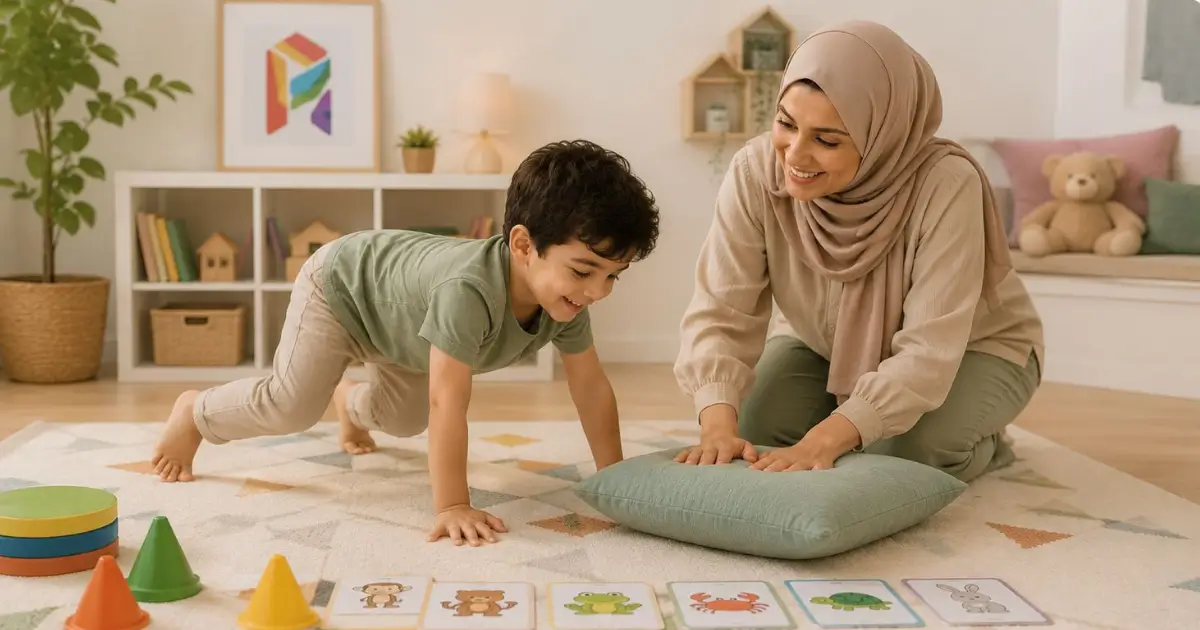
If your child is constantly moving, jumping on the sofa, climbing, unable to sit still, or seems to “never be still,” you might feel you have a stubborn or simply hyperactive child.
And if your child is bothered by the sound of the vacuum cleaner, the blender, clothes, haircuts, crowds, lights, or certain places, you might hear comments like:
“Spoil him less.”
“Just get him used to it.”
“All children can handle it.”
“He’s overreacting.”
But sometimes it’s not about being spoiled or stubborn.
The child may need sensory processing to help their body receive sounds, touch, movement, and light in a calmer way.
The topic of sensory integration for children at home is very important because it explains to us that some of the behaviors we see as “chaos” or “excess energy” may actually be the child’s body’s way of seeking balance.
This article helps you understand sensory challenges in a practical way, and gives you safe steps and simple games to help the child calm their body and regulate their energy at home, without complicated tools and without exaggerated medical promises.
A quick summary for busy moms:
If you don’t have time to read the whole article right now, here’s the main point:
A very active baby doesn’t always need to be “stifled.”
And a baby sensitive to sounds or clothing doesn’t always need to be “forced to get used to it.”
In many cases, we need to understand what’s happening in the baby’s body, and then help them with safe, short, and gradual sensory interventions.
Start with these guidelines:
A hyperactive or high-energy child does not always need to be ‘restricted in movement.’ Similarly, a child who is sensitive to sounds or textures does not always need to be ‘forced to adapt.
- Observe what upsets your child or increases their energy.
- Don’t restrict movement entirely; instead, guide it towards structured and safe activities.
- Don’t force your child to touch or wear something that bothers them without gradual introduction.
- Minimize stressors: less noise, dim lighting, less talking.
- Use a short, repetitive calming routine.
- Practice sensory activities during calm times, not just during outbursts.
- Consult a professional if difficulties are daily or affecting school, sleep, and routines.
The goal is not for the child to be calm all the time.
The goal is for their body to find a safer path to calmness and balance.
What does sensory integration mean for children?
Sensory integration refers to the way a child’s brain receives and processes information from their body and environment, enabling them to act calmly and with focus.
This information may come from:
- Sound
- Touch
- Movement
- Balance
- Light
- Smells
- Taste
- Body pressure
- The sense of the body’s position in space.
When sensory integration works properly, a child can pay attention, play, switch between activities, tolerate everyday sounds, dress themselves, eat, and sleep better.
When the child’s body finds it difficult to regulate these signals, behaviors such as:
- Hyperactivity or high energy.
- Constant jumping and climbing.
- Discomfort or irritation caused by sounds.
- Rejection of certain clothing.
- Sensitivity to haircuts or face washing.
- Crying in crowded places.
- Difficulty sitting still for homework.
- Temper tantrums after crowds or screen time.
- A craving for deep pressure or firm hugs.
- Avoiding touch, sand, or playdough.
- Covering ears from normal sounds.
- Difficulty transitioning between activities.
Therefore, when we talk about sensory integration for children at home, we are not talking about home-based medical treatment.
We are talking about understanding the child’s body’s needs and providing safe activities that help them regulate their daily routine.
Does High Energy Always Mean a Problem?
Not always.
Many children have high energy levels, and this is normal at many ages. Children need movement, play, running, jumping, and exploration.
However, we should start paying closer attention if this high energy:
- Constant for most of the day.
- Causes accidents or unsafe behaviors.
- Negatively impacts sleep quality.
- Makes the child unable to sit still for even a few minutes.
- Causes daily conflicts at home.
- Affects school performance or the daily routine.
- Intensifies after screen time or being in crowded spaces.
- Turns into tantrums when attempts are made to stop it.
- Makes the child seem “out of control” most of the time.
In this case, we don’t simply say, “He’s an active child.”
We begin with a more specific question:
Does he need structured activity?
Are there stimuli that increase his excitability?
Is his body seeking pressure or movement?
Is his routine unclear?
Does he need an evaluation from a specialist?
Is Sensitivity to Sounds or Clothing Normal?
Some levels of sensitivity can be perfectly normal, especially in young children.
Some children dislike certain sounds, refuse certain fabrics, or are bothered by haircuts.
But a clearer plan is needed if the child:
- Frequently covers their ears.
- Cries at ordinary, everyday sounds.
- Rejects most types of clothing.
- Cannot tolerate haircuts or nail clipping.
- Breaks down completely in crowded places.
- Avoids playing with sand, playdough, or water.
- Rejects many types of food due to their texture.
- Experiences daily anxiety caused by touch or sounds.
- Their sleep, daily routine, and school performance are negatively affected.
- Withdraws from activities they love because of sensory triggers.
Sensory sensitivity doesn’t mean a child is being “spoiled.”
Their body may be interpreting sound or touch as something unpleasant or threatening, even if it seems normal to us.
The difference between a child who seeks movement and a child who is highly sensory
Not all sensory children are the same.
Some children seek out stimuli.
Some avoid them.
Some combine both.
The child seeking movement
You might notice that he/she:
- Jumps a lot.
- Loves pushing and pulling.
- Climbs.
- Runs around the house.
- Loves tight hugs.
- Carries relatively heavy objects.
- Bushes into furniture.
- Loves active games.
- Responds to structured physical activity.
This child often doesn’t just need to “sit.”
Needs structured movement before sitting.
Sensory-Sensitive Child
You might notice that he/she:
- Is bothered by noises.
- Refuses certain clothes.
- Doesn’t like having his/her hair cut or brushed.
- Gets stressed in crowded places.
- Is bothered by bright lights.
- Refuses the texture of sand or dough.
- Cries at sudden noises.
- Wants quiet or withdraws.
This child doesn’t need sudden changes.
He/She needs a gradual approach, anticipation, and a less crowded environment.
Combination-Type Child
Some children crave movement but are also sensitive to sounds or touch.
For example:
A child who jumps around a lot but covers their ears from the sound of the vacuum cleaner.
A child who loves vigorous activity but refuses a certain fabric.
A child who runs around the house but collapses in the market.
Here, we need a more nuanced plan: safe movement + reduced stimuli + a clear routine.
Why do sensory challenges affect focus, routine, and anger?
When a child’s body is overstimulated, concentration becomes more difficult.
Imagine trying to read a book while there’s a constant, annoying noise, your clothes are bothering you, the lighting is bright, and someone is telling you to do a lot of things quickly.
This is similar to what some children might feel.
Therefore, we might see:
- Distractibility.
- Impulsiveness.
- Rejection of routine.
- Temper tantrums.
- Difficulty with homework.
- Refusal to go out.
- Crying in crowds.
- Resistance to sleep.
- Excessive movement before sitting down.
- Irritability after a long day.
In this case, body regulation may help the child prepare for learning and calm down, but it does not replace professional evaluation if the difficulties are severe or persistent.
When do we need a specialist?
Consult a specialist if the sensory challenges:
- Are daily and frequent.
- Are affecting school or daycare.
- Are affecting sleep or eating.
- Are causing severe temper tantrums.
- Are causing the child to avoid many activities.
- Are causing unsafe behaviors due to movement.
- Are affecting relationships with siblings or friends.
- Are not improving despite organizing the environment and routines.
- Are present with language delays, communication difficulties, or significant anxiety.
- Are causing constant stress for the entire family.
The appropriate specialist may be a pediatrician, occupational therapist, psychologist, or a multidisciplinary team, depending on the case
How can I safely start at-home sensory regulation?
The idea isn’t to overwhelm your child with too many activities at once.
The idea is to observe, experiment calmly, and choose what truly helps.
The golden rule:
Start with a short, safe, supervised activity.
Then observe: Is your child calmer? Or more excitable?
Not every activity is suitable for every child.
What calms one child might upset another.
7 practical steps for sensory integration for children at home
Step 1: Observe the Child’s Pattern
Before you begin any activity, observe:
- When does his energy surge?
- What sounds upset him?
- What clothes does he refuse to wear?
- Does he get angry after using a screen?
- Does he calm down after physical activity?
- Does he like being squeezed or does he resist touch?
- Does he get stressed in crowded places?
- Does he calm down in a quiet room?
- Does he need physical activity before homework?
- Does the outburst occur after a long day?
Write down simple notes for 3 days.
We do not want a diagnosis.
We want to understand the pattern.
Step 2: Give a controlled movement before sitting down
If your child is hyperactive, don’t start right away with “sit and focus.”
Before homework or a quiet activity, try:
- 3 minutes of animal walks.
- 10 palm presses.
- Carrying a pillow from place to place.
- 10 push-ups against a wall.
- Small jumps on a safe mat.
- Slow crawling like a tortoise.
- Then move directly to a short, quiet activity.
The idea:
Release energy in a structured way, then use that quiet moment.
Step 3: Reduce Triggers During Stress
When you notice your child starting to get stressed, don’t give more instructions.
Tone down the environment:
- Less sound.
- Dimer lighting.
- Only one toy.
- Less talking.
- Fewer people around, if possible.
- Move to a quiet place.
- Turning off screens.
- Give only two choices.
During high arousal, simplicity is better than lengthy explanations.
Step 4: Use transition alerts
A sensory-oriented child may be anxious about surprises.
Before moving from one activity to another, say:
“In two minutes, we’ll turn off the toy.”
“After this round, we’ll tidy up.”
“After the timer goes to the bathroom.”
“After the story, we’ll turn off the light.”
A timer or a transition card can be used.
The goal is for the child’s body to know what’s coming, rather than feeling that the change came suddenly.
Step 5: Do Not Force the Child into Discomforting Triggers
If the child dislikes a particular fabric, sound, or texture, don’t start by forcing them.
Begin gradually.
Clothing example:
- Choose a softer fabric.
- Remove any annoying labels.
- Let him choose between two options
- Try on new clothes at a quiet time.
- Don’t try them on for the first time five minutes before going out.
Example of sounds:
- Alert him before the sound.
- Explain what will happen.
- Move him a step away.
- Use a quieter place.
- Practice him gradually when he is ready.
Step 6: Establish a short calming routine
Choose a routine that’s just 3 minutes long.
Example:
- Clap your palms for 10 seconds.
- Take a deep breath.
- Hug a pillow or sit in a quiet corner.
Repeat it daily during calm times, not just when you’re having a meltdown.
Repetition teaches your child’s body how to return to a calm state.
Step 7: Observe the effect after the activity
After any sensory activity, ask yourself:
- Is the child calmer?
- Is their excitability increased?
- Are they more focused?
- Were they able to move on to the next activity?
- Did they enjoy the activity or dislike it?
- Did they need less time to calm down?
If the mess increases after a particular activity, don’t repeat it in the same way.
The activity might be too strenuous or inappropriate for your child.
If your child is easily upset by noises, has high energy levels throughout the day, or simply doesn’t know where to begin, start with our free trial.
We’ll recommend the most suitable box or package based on your child’s age and needs: sensory, focus, emotional, or routine-related.
7-Day Plan for Sensory Organization at Home
This plan is suitable as a safe start, provided it is implemented calmly and under supervision.
Day 1: Write down the triggers
Write down the top 3 things that most upset your child or increase their energy.
Example:
- The sound of the vacuum cleaner.
- Turning off the screen.
- Clothes.
- Going to the market.
- Homework.
- Bedtime.
- Crowded places.
Day 2: Choose a safe movement activity
Choose just one activity, such as:
- Bear walk.
- Pushing the wall.
- Carrying a pillow.
- Little jumps on a mat.
Do it for 2–3 minutes, then observe the effect.
Day 3: Create a Quiet Corner
A quiet corner is not a punishment.
It can contain:
- A pillow.
- Soft lighting.
- A breathing card.
- A simple sensory toy.
- A short book.
- Emotion cards.
- A water bottle.
Sit there with your child when they are calm so that the space becomes associated with comfort.
Day 4: Use a transition reminder
Choose one challenging transition, such as turning off the screen or going to bed.
Say:
“In two minutes we’ll turn off.”
Then: “Time’s up, now we’re going to transition.”
Use the same phrase every day.
Day 5: Practice a calming technique
Choose one:
- Clenching your palms.
- Breathing deeply.
- Hugging a pillow.
- Drinking water.
- Sitting in a quiet corner.
Use it when things are calm, not just when you’re angry.
Day 6: Combine Movement and Calm
Follow this sequence:
- 3 minutes of structured movement.
- 1 minute of calm.
- 5 minutes of quiet activity.
Example:
Walking animals → Clap your palms → Playing cards or reading a short book.
Day 7: Review What Worked
Ask yourself:
- Which activity calmed them down?
- Which activity increased their movement?
- Do they need a warning before loud sounds?
- Do they need movement before doing homework?
- Do they calm down in the calm corner?
- Are clothing or sounds the primary trigger?
- Do we need a deeper plan or a specialist?
Safe Sensory Activities Indoors
1- Animal Walks
Suitable Age: 3–9 years
Duration: 3 minutes
Objective: To release energy in a structured way
Choose 3 movements:
- Bear Walk: On hands and feet.
- Bunny Jump: Small jumps on a rug.
- Tortoise Crawl: Slowly on the floor.
- Penguin Walk: Small steps.
- Cat Stretch: Slow stretching.
Then move directly to a quiet activity.
2- Wall Push
Suitable Age: 4–12 years
Duration: 1 minute
Objective: Safe physical exertion that helps some children develop coordination
Say:
“Place your hands on the wall and push as if you are moving it.”
Count to 10, then rest.
Repeat only twice.
3- Pillow Carrying
Suitable Age: 4–10 years
Duration: 2–3 minutes
Objective: To develop coordination and muscle activity
Ask your child to carry a pillow from one room to another or arrange pillows on the bed.
Do not use heavy or dangerous objects.
The goal is a safe and simple activity.
4- Palm Squeezing
Suitable Age: 3–13 years
Duration: 30 seconds
Objective: Quick calming
Say:
“Squeeze your palms together for 5 seconds… then release.”
Repeat 3 times.
This activity is simple and can be used before homework, bedtime, or commuting.
5- pillow hug
Suitable Age: 3–10 years
Duration: 1 minute
Objective: To soothe children who like to squeeze a pillow
Let the child hug a pillow with comfortable firmness.
Say:
“Squeeze the pillow… then release.”
If the child doesn’t like squeezing, don’t force them.
6- Calm Box
Suitable Ages: 3–12 years
Duration: As needed
Purpose: To provide safe sensory alternatives
Can contain:
- A stress ball.
- A breathing card.
- A soft fabric.
- A simple sensory toy.
- A small book.
- A drawing sheet.
- A crayon.
A “I need a break” card.
Use the box during calm time first.
7- Sensory Bedtime Routine
Suitable Age: 3–10 years
Duration: 5 minutes
Objective: To reduce stimulation before bedtime
Example:
- Soft lighting.
- Low volume.
- Pump your palms.
- Short story.
- Turn off screens a suitable time before bedtime.
Do not add intense physical activities right before bedtime if they increase your child’s energy levels.
How do I deal with sound sensitivity?
If your child is sensitive to noise, try the following:
- Alert them before the noise.
- Minimize surprises.
- Give them the option to move away.
- Use a quieter place.
- Reduces the number of sounds in the room.
- Avoid making fun of their discomfort.
- Teach them the phrase, “It’s too loud; I need some quiet.”
- Use an predictive routine before going to crowded places.
Practical example:
Before turning on the blender, say:
“The blender will start working in a little while and it will be quite loud. Would you like to stand here or in the other room?”
This gives the child anticipation and control, instead of surprise.
How to Deal with Clothing Sensitivity?
If your child rejects clothes, do not start the battle right before going out.
Try:
- Removing uncomfortable internal tags.
- Choosing softer fabrics.
- Washing new clothes before wearing them.
- Trying out clothes during a calm time.
- Offering only two options.
- Not forcing them into something that causes a severe meltdown.
- Preparing clothes the night before.
- Monitoring what bothers them specifically: the fabric, tightness, seams, socks, or the collar.
Say:
Understanding doesn’t mean having no boundaries.
It means solving the problem instead of turning it into a daily struggle.
“I understand that this fabric bothers you. We can choose between this and that.”
How do I deal with a hyperactive child?
A common mistake is trying to stop the movement completely.
The best approach:
- Give him organized movement.
- Designate a safe place for movement.
- Use a short activity before sitting down.
- Break down the task into smaller parts.
- Use short breaks.
- Prevent only dangerous movement.
- Praise organized movement.
Example:
“Jumping on the couch is unsafe. You can do 10 small jumps on the carpet.”
You’re not preventing the need to move.
You’re guiding it.
Common mistakes that increase sensory challenges
Mistake 1: Completely Ban Movement
If a child is seeking movement, completely restricting it may increase tension and impulsivity.
It’s best to channel the movement into a safe activity.
Mistake 2: Forcing Them into Discomforting Triggers
Forcing the child into a sound, texture, or fabric that bothers them may increase their fear and resistance.
The better approach: Gradual exposure, predictability, and choices.
Mistake 3: Talking Too Much When Aroused
During arousal, too much talking becomes even more arousing.
Use few words:
“Quiet.”
“Breath.”
“A quiet place.”
“One of two options.”
Mistake 4: Allowing movement to become dangerous
Sensory regulation does not mean allowing jumping from heights or dangerous climbing.
Safety first.
We allow movement, but within clear boundaries.
Mistake 5: Ignoring screen time
Some children become more irritable after screen time, especially before bedtime or homework.
Observe the effect of screen time on your child and notice if they become more hyperactive or irritable afterward.
Mistake 6: Using the same activity with all children
Not every activity suits every child.
One child calms down with pressure.
Another child resists pressure.
One child calms down with movement.
Another child becomes more active after jumping.
Observation is more important than a ready-made formula.
If sensory stimulation causes anger, distraction, or difficulty with routines, start with a free trial.
It will help you determine the most suitable starting point with a clear plan, rather than random experimentation.
How Do I Know That Sensory Regulation Is Starting to Help?
Look for small signs such as:
- The child calms down more quickly.
- Risk jumping decreases.
- They can sit still for longer periods.
- They accept a previously difficult transition.
- They use a quiet corner.
- They ask for a break instead of a tantrum.
- They tolerate noise after prior warning.
- They refuse clothes a little less.
- Tantrums become shorter.
- Homework or bedtime becomes a little easier.
Do not expect a complete change within days.
Sensory regulation requires observation, repetition, and gradual progress.
When Does the Sensory Regulation Box Help?
The sensory regulation box helps when a mother needs clear tools and an implementation plan, instead of constantly trying random activities every day.
It may be appropriate if your child:
- High in energy and not easily calmed.
- Needs movement before sitting down.
- Disturbed by noises or crowds.
- Rejects certain clothes or textures.
- Gets angry after stimulation.
- Is easily distracted by his surroundings.
- Needs a quiet corner and simple tools.
- Needs a short daily schedule.
- Needs safe activities instead of risky movements.
The box does not help simply because it contains toys.
It helps because it turns sensory regulation into simple, visual, and repeatable steps.
What Can the Sensory Regulation Box Contain?
Depending on the age group and the box type, it may contain:
- Safe sensory tools.
- Calming cards.
- Structured movement activities.
- Hand-pressure exercises.
- Simple balance games.
- Gradual tactile activities.
- Transition cards.
- A 10-day implementation plan.
- A simplified guide for the mother.
- A QR code for explanatory videos.
- A progress tracking form.
- Ideas for the calm corner.
- WhatsApp support or a guidance call, depending on the package tier.
The most important thing is for the mother to use these tools in a safe and gradual manner, rather than as a quick fix for every situation.
Does Sensory Integration Treat Hyperactivity or Anger?
It is best not to use promises like “treats” or “ends the problem.”
Sensory regulation may help some children calm their bodies, improve readiness to focus, reduce overstimulation, and ease transitions between activities.
However, if the child has severe hyperactivity, clear school difficulties, anxiety, speech delay, or unsafe behaviors, relying on at-home activities alone is not enough.
At-home activities are a useful support, but they are not a diagnosis or a medical treatment.
Important professional clarification
Play Therapy Box offers educational and behavioral support to help children develop their skills at home. It is not a medical diagnosis and is not a substitute for occupational therapy, psychotherapy, or medical follow-up when needed.
This article is for educational and practical guidance. If your child has severe sensory difficulties, unsafe behaviors, or a clear impact on school, sleep, and eating, it is best to consult a qualified professional.
Summary: How do I start today?
Sensory integration for children at home begins with observation, not with buying lots of toys or trying random activities.
Start today with these steps:
- Observe what triggers your child’s excitement.
- Determine if they are seeking movement, are sensitive to stimuli, or both.
- Use structured and safe movements before sitting down.
- Minimize noise, lights, and talking during times of stress.
- Give a warning before moving on.
- Don’t force your child to engage in distressing stimuli without gradual introduction.
- Establish a short calming routine.
- Observe whether the activity soothes or increases excitement.
- Consult a professional if the difficulties are severe or occur daily.
Whenever you feel you don’t know whether your child needs a sensory box, a focus box, an emotions box, or a routine, you can start with the free quiz to suggest the most suitable path based on the child’s age and needs.
Start now and get your recommendation in a minute.
A simple, free test will recommend the most suitable box or package for your child’s age and needs.
FAQ
No. Many children naturally have high energy levels. However, if the movement is daily, intense, and impacts their sleep, schooling, safety, or daily routine, the child may need a regulation plan or a specialist evaluation.
It means using safe steps and activities that help the child regulate how they process sound, touch, movement, and light inside the home such as structured movement, reducing triggers, and utilizing a calm corner.
They may be sensory-sensitive if they are frequently bothered by sounds, clothing, haircuts, crowds, lights, or certain textures, especially if these things disrupt their day and routine.
Allow safe and controlled movement, and discourage dangerous activity. Instead of jumping on furniture, use a rug, walk around with animals, push against walls, or carry a pillow.
Observe what bothers them: the fabric, the stitching, the tightness, the tags, or the socks. Choose more comfortable fabrics, remove the tags, and try on clothes at a quiet time with only two options.
Alert them before the sound, give them the option to move away, minimize surprises, and use a quiet place. Don’t make fun of their fear or force them to suddenly tolerate the sound.
No. The box is an at-home support tool to develop regulation and calmness, and it is not a substitute for occupational therapy, diagnosis, or medical follow-up when needed.
If the sensitivity or hyperactivity is severe, occurs daily, affects school, sleep, or eating, causes unsafe behaviors, or does not improve despite gradual and consistent treatment, it is best to consult a specialist.
It varies depending on age, the severity of the difficulty, and consistency in application. Watch for small signs over two to four weeks, such as calming down more quickly, accepting transitions more easily, or reducing dangerous movements.
Suggested reliable external links
- American Occupational Therapy Association — Sensory Integration Approaches for Children and Youth
- Royal College of Occupational Therapists — Sensory Approaches for Children and Young People
- NHS — Sensory Strategies for Parents
- NHS — Helping Your Child with Sensitivities
- CDC — Parent Training in Behavior Management
- HealthyChildren.org — Behavior Therapy Parent Training


