
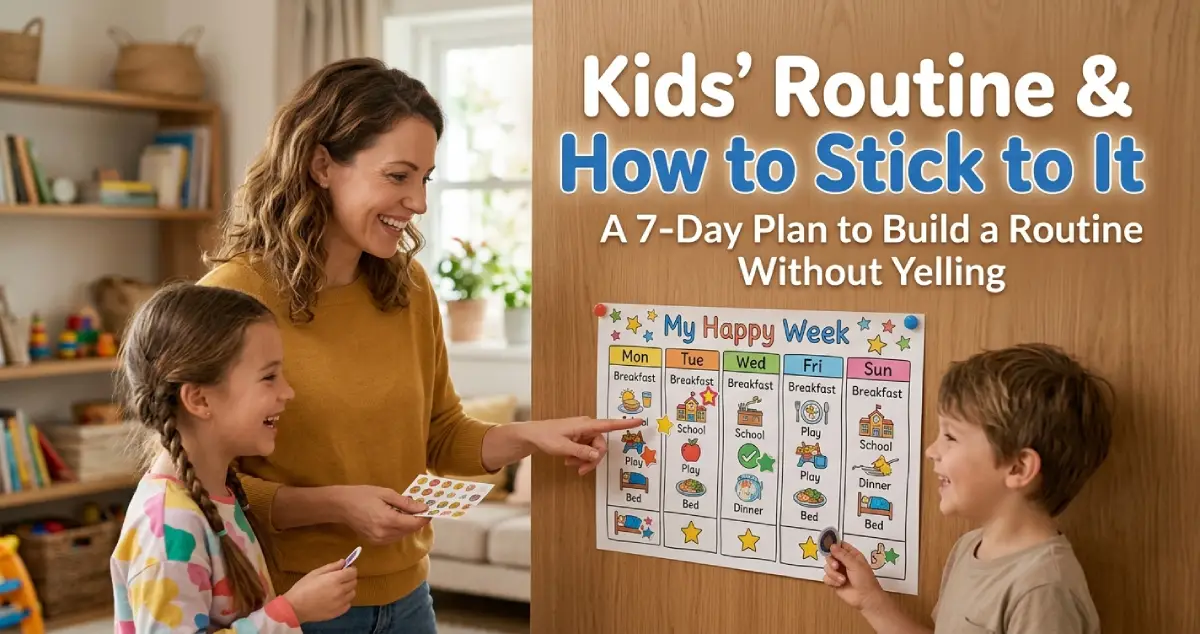
If every day with your child feels like a series of little battles, you’re definitely not alone.
“Get up.”
“Brush your teeth.”
“Put your clothes on.”
“Clean up your toys.”
“Turn off the screen.”
“It’s bedtime.”
Then the delays start. They refuse, cry, negotiate, run away, or suddenly have a meltdown.
At that point, many parents ask themselves:
Why does my child keep resisting the routine?
Is it just stubbornness?
Am I doing something wrong?
How can I build a clear routine without yelling every day?
The truth is, getting kids to follow a routine isn’t just about giving more instructions. Children don’t stick to routines because we repeat ourselves over and over. They do better when the routine is clear, simple, predictable, and matches their age and ability to move from one activity to the next.
This guide will help you understand why children resist routines and give you a practical 7-day plan to build a simple daily routine at home, along with easy games and tools that encourage cooperation instead of constant resistance.
A quick note: Select your child’s age on the guide page.
A Quick Summary for Busy Moms
If you don’t have time to read the whole article right now, here’s the main takeaway:
When children resist a routine, it doesn’t always mean they’re being disrespectful or badly behaved. Many kids struggle with routines because they don’t know what’s coming next, find it hard to switch from one activity to another, feel overwhelmed by too many steps, or are given instructions too quickly and under stress.
Start with these simple rules:
- Don’t try to fix the whole day at once.
- Focus on just one routine, like bedtime, getting ready to go out, homework, or tidying up.
- Keep the routine to just three steps.
- Use a simple visual schedule or picture cards.
- Give your child a warning before it’s time to switch activities.
- Offer only two choices.
- Praise effort and consistency, not perfection.
A successful routine isn’t a strict one.
It’s a routine that’s clear enough to help your child feel safe, but flexible enough that they can actually stick with it.
What Is a Children’s Routine?
A children’s routine is a daily sequence that helps your child know what’s happening now and what comes next.
A routine can be for:
- Morning time
- Bedtime
- Homework
- Leaving the house
- Coming home from school
- Cleaning up toys
- Turning off screens
- Bath time
- Mealtime
Having a routine doesn’t mean your home has to feel like a military camp.
It also doesn’t mean your child has no choices.
A routine simply helps your child avoid feeling like every transition is a new surprise.
When children know what comes next, they usually feel less anxious, delay less, and are much more likely to follow directions.
Why Do Children Resist Routines?
There isn’t just one reason why kids push back against routines. In most cases, it’s a mix of different factors.
1. Switching Between Activities Is Hard
Some children aren’t resisting the task itself—they’re struggling with the transition.
For example:
- They don’t mind brushing their teeth, but they don’t want to stop playing to go to the bathroom.
- They don’t mind going to bed, but they don’t want to turn off the screen.
- They don’t mind leaving the house, but they don’t want to stop what they’re doing.
Moving from something fun to something they have to do is a skill that takes practice.
That’s why simply saying, “Come on, it’s time,” usually isn’t enough.
Children often need a smooth transition between activities.
2. Too Many Steps at Once
Imagine saying:
“Clean up your toys, wash your hands, get dressed, pack your bag, don’t forget your shoes—we’re late!”
To a child, that can feel like a huge mountain to climb.
Children who struggle with organization or attention can easily get overwhelmed by so many instructions.
It may look like they’re refusing, when really they just don’t know where to start.
The best routines begin with just a few simple steps.
3. Instructions Are Given Under Stress
Many parents start calmly, but after repeating themselves several times, the tone changes.
“How many times have I told you?”
“You never listen.”
“It’s the same thing every single day.”
“Hurry up!”
The more stressful the situation becomes, the more some children resist.
Not because they’re trying to upset their parents, but because stress makes it harder for them to stay calm and cooperate.
4. Your Child Can’t See What’s Coming Next
Adults naturally understand how the day flows.
They know dinner is followed by brushing teeth, then bedtime.
Young children often don’t think that way.
They’re focused on what’s happening right now.
That’s why visual schedules and picture cards work so well.
Instead of only hearing, “We’ll go to bed soon,” they can actually see the sequence:
Pajamas → Brush Teeth → Story → Bed
5. Children Need to Feel Some Control
Some kids resist routines because they feel like every decision is made for them.
Parents say, “Do this.”
Teachers say, “Do this.”
The schedule says, “Do this.”
So they try to regain a sense of control by saying no.
The answer isn’t to let them control the whole day.
Instead, offer small choices within clear limits.
For example:
- “Do you want the blue pajamas or the white ones?”
- “Should we brush your teeth first or read the story first?”
- “Would you like to flip the routine card, or should I do it?”
Small choices often reduce power struggles.
6. The Routine Isn’t Consistent
If bedtime is 8:00 tonight, 11:00 tomorrow, and completely different the next day, it’s hard for your child to know what to expect.
Children do best with routines that are fairly consistent.
The day doesn’t have to be perfect, but the main steps should happen in roughly the same order most of the time.
7. Your Child Is Tired, Hungry, or Overstimulated
Sometimes the routine starts at the worst possible moment.
A child who’s exhausted may melt down instead of cooperating.
A hungry child may refuse everything.
A child who’s just finished a long screen session may find it especially difficult to switch to something else.
That’s why the timing of the routine is just as important as the routine itself.
Is It Normal for Children to Resist a Routine?
Yes. It’s completely normal at certain stages, especially for younger children or during times of change.
Children may resist routines more when they’re:
- Starting school or daycare
- Moving to a new home
- Adjusting to a new baby in the family
- Experiencing changes in their sleep schedule
- Traveling
- Recovering from an illness
- Coming back from a vacation
- Spending more time on screens
- Feeling stressed by school or homework
In most cases, children improve when the routine becomes simpler, clearer, and easier to follow.
When Do You Need a Better Plan?
A more structured approach may help if your child’s resistance to routines:
- Happens on most days
- Leads to daily yelling or arguments
- Turns bedtime or leaving the house into a constant battle
- Starts affecting school or homework
- Causes your child to melt down during every transition
- Leaves you feeling like you’re repeating yourself with no results
- Comes with frequent distractibility, impulsive behavior, or repeated outbursts
- Creates ongoing chaos at home
- Doesn’t improve despite your efforts
When this happens, the answer usually isn’t more yelling.
What your child needs is a routine that’s simpler, more consistent, and easier to understand.
Is It Normal for Children to Resist a Routine?
Yes. At certain ages, especially during the early years or times of change, it’s completely normal for children to push back against routines.
Routine resistance may become more noticeable when your child is:
- Starting school or daycare
- Moving to a new home
- Adjusting to the arrival of a new sibling
- Going through changes in their sleep schedule
- Traveling
- Feeling sick or recovering from an illness
- Returning from a vacation
- Spending more time on screens than usual
- Under pressure from school or homework
The good news is that, for most children, things improve when the routine is made simpler, clearer, and more predictable.
When Is It Time for a Better Plan?
You may need a more structured approach if your child’s resistance to routines:
- Happens most days
- Leads to daily yelling or constant arguments
- Turns bedtime or leaving the house into a struggle
- Starts affecting school or homework
- Causes frequent meltdowns during transitions
- Leaves you feeling like you’re saying the same things over and over with no change
- Comes with significant distractibility, impulsive behavior, or repeated anger
- Creates ongoing chaos at home
- Doesn’t improve even after you’ve tried different approaches
In these situations, the solution usually isn’t to raise your voice.
What helps most is a routine that’s simpler, more consistent, and easier for your child to follow.
How Routine Resistance Looks at Different Ages
Ages 3–6
At this age, children learn best through pictures, repetition, and simple steps.
Routine resistance may look like this:
- Running away when it’s time to get dressed
- Refusing to brush their teeth
- Crying when screen time ends
- Delaying bedtime
- Refusing to clean up toys
- Jumping from one activity to another without finishing
- Needing constant reminders
At this stage, long explanations usually don’t help.
Instead, use picture cards, playful activities, timers, and offer just two simple choices.
Ages 7–9
As children get older, school, homework, and more structured schedules become part of daily life.
Resistance may look like:
- Putting off homework
- Forgetting to pack their school bag
- Resisting the bedtime routine
- Delaying when it’s time to leave the house
- Needing reminders for every step
- Getting upset when it’s time to stop playing or turn off screens
At this age, a simple routine chart, involving your child in creating it, and rewarding consistency can make a big difference.
Ages 10–13
By this stage, routine resistance often sounds more like arguing or procrastinating.
You might hear things like:
- “I’ll do it later.”
- “I forgot.”
- “Why now?”
- “I don’t need a schedule.”
- “I can handle it myself.”
Instead of turning routines into a list of commands, work together to create a clear agreement.
Try asking questions like:
- “What part of your day do you waste the most time on?”
- “How can we make homework easier to manage?”
- “What three routine steps should we stick to this week?”
Ages 14–17
With teenagers, treating them like younger children usually doesn’t work.
They need respect and independence, but they still benefit from a clear structure.
Routine resistance at this age may include:
- An inconsistent sleep schedule
- Procrastinating on schoolwork
- A messy room
- Spending too much time on their phone
- Resisting reminders
- Getting frustrated when limits are set
Instead of saying, “I’m making a schedule for you,” try saying:
“Let’s come up with a system that helps you stay on track without me reminding you ten times a day.”
Why Does More Pressure Often Lead to More Chaos?
When things are already stressful, adding more pressure usually makes it even harder for your child.
You notice they aren’t following the routine, so you give more instructions.
Your child feels overwhelmed and pushes back even more.
You become frustrated, which raises the tension.
Then your child either melts down or refuses altogether.
The next day, the same cycle starts again.
This cycle isn’t broken by speaking louder.
It’s broken by using smaller steps, fewer words, and smoother transitions.
The Golden Rule for Building a Routine
Start with the smallest step your child can successfully manage.
You don’t need to create a perfect daily routine in the first week.
Choose just one routine.
Keep it to three simple steps.
Practice it consistently for several days.
Then add only one new step at a time.
A routine that’s simple, successful, and lasts is always better than a perfect routine that falls apart on the second day.
7-Day Plan to Build a Routine Without Yelling
This plan is simple and practical. Start with just one routine, such as bedtime, leaving the house, homework, or cleaning up toys.
Day 1: Choose Just One Routine
Don’t try to fix everything at once.
This isn’t the week to work on bedtime, mornings, homework, cleaning up, and screen time all together.
Pick the routine that’s causing the most stress right now.
For example:
- Bedtime
- Leaving the house
- Homework
- Toy cleanup
Take a moment to notice what usually happens.
Ask yourself:
- When does the struggle usually begin?
- Which step does your child resist?
- Are they resisting the first step or the transition?
- Is the problem the timing or the way the routine is presented?
Day 2: Keep the Routine to Just Three Steps
Simplify the routine as much as possible.
1.Example bedtime routine:
- Put on pajamas
- Brush teeth
- Read a short story
2.Example leaving-the-house routine:
- Put on shoes
- Grab the backpack
- Stand by the door
3.Example homework routine:
- Open the notebook
- Complete two questions
- Take a short break
Don’t add a fourth step yet.
Right now, the goal is success—not perfection.
Day 3: Make a Simple Visual Schedule
Use pictures, symbols, or small cards.
It doesn’t have to look perfect.
Even a sheet of paper with three simple pictures is enough.
After each step, let your child:
- Flip the card
- Check it off
- Add a sticker or star
- Move the card to a “Done” section
When children can see what’s next, they need fewer reminders.
Day 4: Give a Transition Warning
Before it’s time to switch activities, give your child a heads-up.
For example:
- “In two minutes, we’ll put on our pajamas.”
- “When this song ends, it’s time to turn off the screen.”
- “After this round, we’ll clean up the blocks.”
- “When the timer goes off, we’ll start homework.”
Then follow through.
Children often need a little time to finish what they’re doing before moving on.
Sudden transitions usually lead to more resistance.
Day 5: Offer Only Two Choices
Small choices can prevent big power struggles.
Instead of saying:
“Get dressed.”
Try saying:
“Would you like to wear the blue shirt or the white one?”
Instead of:
“Brush your teeth.”
Try:
“Do you want to start with the toothbrush or the toothpaste?”
Instead of:
“Clean up your toys.”
Try:
“Should we pick up the blocks first or the cars?”
Giving two choices helps children feel involved while keeping the routine on track.
Day 6: Praise Progress, Not Perfection
Don’t wait for your child to complete the entire routine perfectly before encouraging them.
Celebrate the small wins.
For example:
- “I like that you got started right away.”
- “Great job flipping your routine card.”
- “You needed fewer reminders today.”
- “I like how you got back to the routine after taking a break.”
You can also use a simple reward system.
If your child completes all three steps, they earn one star.
After earning three stars, they get to choose a small activity they enjoy.
The reward doesn’t need to be expensive or exciting.
The goal is to build a lasting habit—not to buy cooperation.
Day 7: Keep It Consistent, Then Add One More Step
Once your child is comfortably following the three-step routine for several days, add just one new step.
For example, the bedtime routine can become:
- Put on pajamas
- Brush teeth
- Read a story
- Turn off the lights
If your child struggles, don’t think of it as a failure.
Simply go back to the original three steps for a couple of days, then try adding the new step again.
Looking for a Ready-to-Use Routine Plan?
Want a simple plan and practical tools to help your child stick to a routine without daily yelling?
Take a look at the Routine & Organization Kit, and choose your child’s age on the kit page to get the guide that’s right for them.
Ready-to-Use Daily Routine Examples
Bedtime Routine
Start with just three simple steps:
- Put on pajamas
- Brush teeth
- Read a short bedtime story
A helpful way to say it:
“In two minutes, we’ll start our bedtime routine. First pajamas, then brushing teeth, then story time.”
Try to avoid:
- Long negotiations
- Repeating threats
- Letting your child use screens until the last minute
- Adding too many steps at the beginning
Morning Routine
Keep it simple with three steps:
- Get dressed
- Eat a quick breakfast
- Grab your backpack and put on your shoes
Place the routine cards near the front door or in your child’s room.
A helpful prompt:
“We have three steps before we leave today. Once we finish each one, we’ll check it off.”
Homework Routine
Three easy steps:
- Open your notebook
- Complete two questions
- Take a short break
Instead of saying, “Finish all your homework,” focus on the very first step.
Toy Cleanup Routine
Break it into three parts:
- Pick up the building blocks
- Collect the toy cars
- Put the books back on the shelf
Use a short timer or turn it into a game, such as:
“Let’s see who can find five toys first!”
Games That Make Routines Easier
Game 1: The Two-Minute Challenge
Best for ages: 3–9
Goal: Make it easier to get started.
Set a timer for two minutes and say:
“Do you think we can get our pajamas on before the timer goes off?”
Or:
“Can we pick up five toys before the timer rings?”
Keep it fun and encouraging, not stressful.
If your child doesn’t finish in time, simply say:
“We got really close! Let’s try again.”
Game 2: The Routine Leader
Best for ages: 4–10
Goal: Encourage cooperation.
Let your child hold the routine cards and announce each step.
For example:
1.“Step one: Brush our teeth.”
2.“Step two: Put on pajamas.”
3.“Step three: Story time.”
When children feel involved, they’re often much more willing to cooperate.
Game 3: Flip the Card
Best for ages: 3–8
Goal: Help children see their progress.
Set out three routine cards.
Each time your child finishes a step, they flip the card over.
The other side can say “Done” or have a smiley face.
That simple action gives children a satisfying sense of accomplishment.
Game 4: Secret Mission
Best for ages: 5–10
Goal: Reduce procrastination.
Say something like:
“Today’s secret mission is to finish the first step without any reminders.”
If they do it, give specific praise:
“I noticed you got started all by yourself. That was great responsibility.”
Game 5: I Choose Where to Start
Best for ages: 6–12
Goal: Reduce resistance by offering choices.
Give your child two options, such as:
“Would you like to start with your backpack or your shoes?”
“Do you want to begin with reading or the first homework question?”
They aren’t choosing whether to do the routine.
They’re simply choosing where to begin.
Common Mistakes That Can Ruin a Routine
Mistake 1: Trying to Build the Perfect Routine in One Day
The bigger and more complicated the routine, the more likely it is to fall apart.
Start small.
Three simple steps are enough.
Mistake 2: Changing the Rules Every Day
If the routine keeps changing, your child won’t know what to expect.
Consistency matters more than being strict.
Mistake 3: Giving Long Explanations During Stressful Moments
When emotions are running high, children aren’t ready for long talks.
Keep your words short and simple.
Try phrases like:
- “First step.”
- “Next card.”
- “After the timer.”
- “Pick one.”
Mistake 4: Relying on Threats Every Day
Threats might work once or twice, but they don’t teach lasting skills.
The goal is to help your child learn how to get started, move from one activity to the next, and follow a routine—not just obey out of fear.
Mistake 5: Starting the Routine Too Late
If you begin the bedtime routine when your child is already exhausted, cooperation becomes much harder.
Start before they reach that point.
Mistake 6: Not Involving Your Child
Even young children like feeling that they’re part of the plan.
Try asking questions like:
- “Which picture should we put first?”
- “What color should we use for this card?”
- “Do you want to flip the card, or should I?”
Small choices help children feel included.
Mistake 7: Expecting Success Without Practice
Following a routine is a skill.
Sticking with it is a skill.
Moving smoothly between activities is a skill.
And like any skill, they all take practice—not just one instruction.
If the daily chaos is draining your energy, start with a ready-made routine instead of fighting the same battles every day.
What If My Child Refuses the Visual Schedule?
Some children resist a visual schedule because it feels like another task they’re being told to do.
Instead, try these ideas:
- Let your child choose the design of the cards.
- Start with just two cards instead of a full schedule.
- Make them the “Routine Leader.”
- Use funny pictures or symbols they enjoy.
- Never use the schedule as a threat.
- Praise them the first time they use it successfully.
If your child still refuses the schedule, don’t force it.
Turn it into a game instead.
What If My Child Has a Meltdown During Transitions?
If your child struggles every time they move from one activity to another, try this approach:
- Give a warning before it’s time to switch.
- Use a visual or audible timer.
- Tell them what will happen next.
- Offer two simple choices.
- Start with one small step.
- Praise the first sign of cooperation.
For example:
“Two more minutes of playtime. When the timer goes off, we’ll put the cars back in the box. Would you like to start with the red cars or the blue ones?”
This works much better than saying:
“I told you playtime is over! Why don’t you ever listen?”
How Do I Know the Routine Is Working?
Don’t expect everything to become perfect overnight.
Look for the small signs of progress:
- Your child starts the first step more quickly.
- They need fewer reminders.
- Their meltdowns become shorter.
- They choose one of the two options you offer.
- They flip the routine card on their own.
- They remember the next step without being told.
- They complete all three steps, even if it takes time.
- Bedtime becomes a little less stressful.
- Leaving the house gets a bit easier.
These small improvements are a good sign that the routine is becoming a habit instead of a daily battle.
When Can the Routine & Organization Kit Help?
The Routine & Organization Kit is designed for parents who want practical tools instead of relying on repeated reminders.
It may be a good fit if your child:
- Resists daily routines
- Delays bedtime or getting ready to leave the house
- Needs constant reminders
- Refuses to clean up toys
- Gets upset during transitions between activities
- Doesn’t know where to start
- Benefits from a visual schedule
- Enjoys hands-on activities that make routines more fun
- Leaves you repeating the same instructions every day
The kit isn’t helpful just because it’s a nice product.
It works because it turns routines into something visual, hands-on, and broken down into small, manageable steps.
What’s Included in the Routine Kit?
Depending on your child’s age and the version of the kit, it may include:
- Visual routine cards
- Step-by-step routine charts
- Organization and sorting activities
- Transition games
- A timer or other helpful routine tools
- Progress stickers
- A parent guide
- A simple implementation plan
- A progress tracker
- A QR code linking to a video guide
- WhatsApp support or a guidance call, depending on the package
The most important part isn’t just having the tools—it’s using them consistently and keeping the routine simple.
Can a Routine Help Children Who Are Very Active or Easily Distracted?
Yes. A clear routine can be especially helpful for children who have difficulty with attention, transitions, or organization.
The routine works best when it’s:
- Short
- Visual
- Consistent
- Easy to follow
- Flexible enough to include movement when needed
- Built around small choices
- Free from yelling and long lectures
The goal isn’t to make your child perfectly calm.
It’s to help them understand what comes next.
When Isn’t a Home Routine Enough?
Consider talking to a qualified professional if your child’s resistance to routines:
- Is extremely intense
- Leads to long daily meltdowns
- Clearly affects school, sleep, or eating
- Comes with significant impulsivity or severe attention difficulties
- Is accompanied by high levels of anxiety
- Results in unsafe behaviors
- Doesn’t improve despite consistent practice and gradual changes
- Happens across different settings, such as both at home and at school
This doesn’t necessarily mean something is seriously wrong.
It simply means your child may benefit from a deeper assessment and more specialized support.
Important Professional Note
The Play Therapy Box provides educational and behavioral support to help children build important skills at home. It is not a medical diagnostic tool, nor is it a replacement for psychological therapy, occupational therapy, or medical care when needed.
This article is intended for educational purposes and practical guidance. If your child has significant challenges, a previous diagnosis, or noticeable difficulties at school, it’s best to consult a qualified professional.
The Bottom Line: How Do I Start Today?
Building a successful routine for your child doesn’t start with yelling, and it doesn’t require a long schedule full of rules.
Start small:
- Choose just one routine.
- Keep it to three simple steps.
- Use picture cards or visual cues.
- Give a warning before each transition.
- Offer only two choices.
- Praise consistency, not perfection.
- Stick with the routine for several days.
- Add only one new step once the routine is going well.
Remember:
A successful routine isn’t the one that looks perfect on paper.
It’s the one your child can actually follow with less stress—and one you can stick with without feeling worn out.
Ready to Build a Calmer Routine Without Daily Yelling?
Check out the Routine & Organization Kit that’s designed for your child’s age, and start building better routines with small, simple steps today.
FAQs
No. A routine is about creating predictability and helping your child feel secure. When children know what comes next, transitions become easier. A good routine is simple and consistent—not strict.
Your child may struggle because they can’t clearly see the steps, the transitions feel too sudden, the routine is too long, or they feel like every decision is being made for them. Start with just three simple steps and use visual routine cards.
Use pictures, keep the steps short, use a simple timer, and offer small choices. Long explanations usually aren’t effective at this age—young children learn best through visuals and repetition.
Turn it into a game. Let your child choose the pictures or flip the routine cards themselves. Start with only two cards, and never use the schedule as a punishment or threat.
It depends on your child’s age, how strongly they resist routines, and how consistent you are. Over the first two to four weeks, look for small signs of progress, such as needing fewer reminders or starting the first step more quickly.
Not always, but they can be helpful in the beginning. Keep rewards simple, and focus on praising your child’s effort and consistency rather than using rewards to buy cooperation.
Yes. A short, visual routine can be especially helpful for children who struggle with attention because it reduces the number of decisions they have to make and clearly shows what comes next.
Here are natural English versions of those trusted external resources:


