
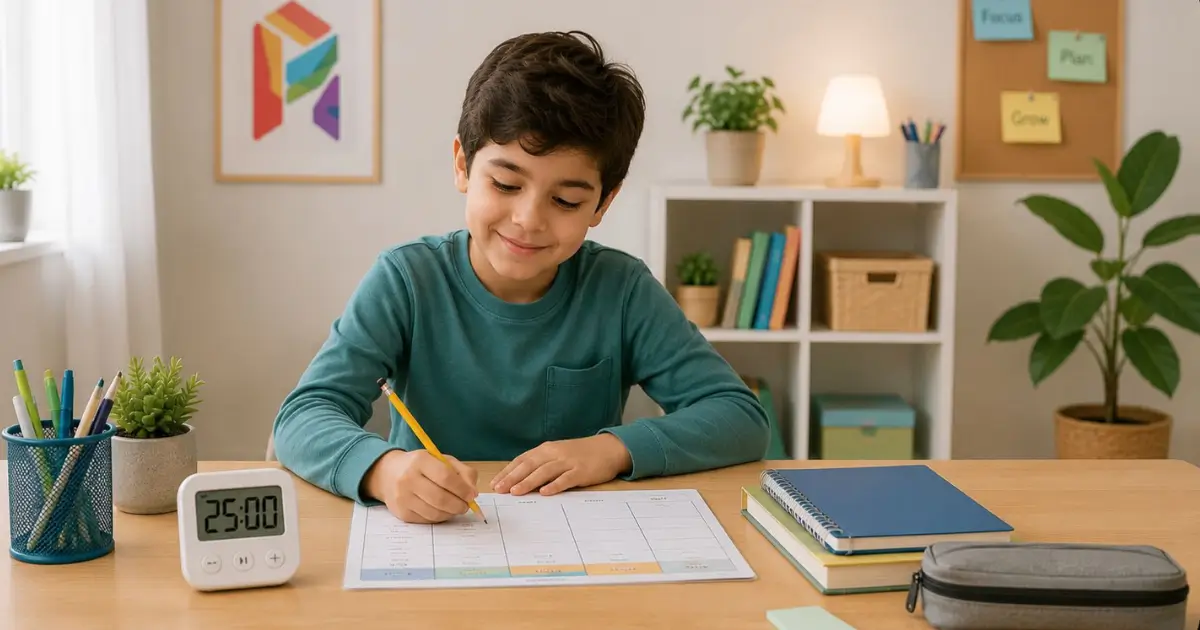
If your child is between 7 and 9 years old and you often hear:
“He can’t concentrate in class.”
“He forgets instructions.”
“He’s late with homework.”
“He starts and then stops.”
“He moves around a lot.”
“School routines have become a battle.”
Then you’re at a stage where you need a different approach.
Ages 7–9 is a real transitional phase. The child is no longer just in the free play phase, but also has not yet acquired all the organizational skills required for school: sitting, paying attention, following instructions, packing the bag, completing homework, and coping with frustration.
Therefore, difficulty concentrating in school doesn’t always mean laziness or lack of interest. Sometimes it means the child needs a clearer routine, smaller tasks, a break after school, and short games that train focus without pressure.
This guide gives you a nice home plan for ages 7-9 that helps with homework, concentration, and school routines.
A quick summary for the busy mom
If you don’t have time to read the entire article, here’s the most important point:
Don’t start homework immediately after school.
And don’t expect your child to complete everything at once.
Start with these rules:
- After-school transition: Water, snack, rest.
- A fixed work area.
- 10 minutes of work + a short break.
- Break down homework into smaller parts.
- List only 3 tasks.
- Praise commitment, not perfection.
- Organize movement if the child is very active.
At ages 7–9, focus is built gradually, not with long commands.
Why does difficulty concentrating appear at ages 7–9?
1- School requires more sitting and attention
At this stage, time spent sitting, doing homework, reading, writing, and doing math increases.
A child who was successful in play and daycare may begin to tire when expectations become higher.
2- The child comes home from school tired
After a day filled with noise, instructions, classmates, transitions, and homework, a child may come home exhausted.
If we start homework immediately, we might see:
- Refusal.
- Crying.
- Distraction.
- Excessive movement.
- Tantrassment.
- Procrastination.
Therefore, transition breaks are very important.
3- The homework Feels overwhelming
When you say:
“Finish the homework.”
The child might hear:
“You have to do something long and difficult.”
The better way:
“Just solve 3 questions.”
Then Take a short break.
4- The environment is full of distractions
The TV, the phone, games, siblings, a crowded table—all of these make it harder to concentrate.
A child aged 7–9 needs a supportive environment, not a testing one.
5- High energy or impulsiveness
Some children can’t transition from a long school day to sitting still immediately.
They need short, structured movements before homework.
Examples:
- Pushing against the wall.
- Walking with animals.
- Little hops on a rug.
- Carrying and organizing a light bag.
When is a simple adjustment enough? And when do we need a clearer plan?
A simple adjustment might be enough if:
- The problem appears only after fatigue.
- The child focuses on activities they love.
- They improve when we break down the task.
- The problem does not affect school very much.
- The routine improves with a clear schedule.
We need a clearer plan if:
- The problem is daily.
- Homework becomes a constant struggle.
- He constantly forgets instructions.
- He refuses to start each day.
- He gets distracted even by short tasks.
- The school routine is inconsistent.
- The teacher notices the same difficulty.
- The child is starting to lose confidence.
- Sleep or screen time clearly affect his concentration.
If the difficulty is severe or persistent, it may be appropriate to consult a specialist.
Home plan for ages 7-9 in 7 days
Day 1: After-school transition break
Before homework, give your child 15–20 minutes of:
- Water.
- A snack.
- A change of clothes.
- A short rest.
- A light chat.
- No screen time if possible.
The idea is to help them unwind from school before starting homework.
Day 2: A Consistent Homework Corner
Choose one place for the assignment.
It will be:
- A clear table.
- A suitable chair.
- Tools and supplies ready.
- Good lighting.
- Games kept away.
- A screen off.
A fixed workspace reduces negotiation and distractions.
Day 3: The 10-minute rule
Start with:
- 10 minutes of activity.
- 1–2 minutes of rest.
- Then another 10 minutes.
If your child tires easily, start with 7 minutes.
A short success is better than a long failure.
Day 4: Break Down the Homework
Instead of:
“Finish the page.”
Say:
“Let’s solve the first 3 questions.”
Afterward:
“Let’s take a short break.”
Then:
“Let’s solve another 3.”
The child needs to see a near end.
Day 5: 3-To-Do List
Write down:
- Homework
- Packing the bag
- Preparing tomorrow’s clothes
Each completed task gets a checkmark.
Don’t list 8 tasks.
Three tasks are enough.
Day 6: Praise Commitment
Say:
“I liked that you sat for 10 minutes.”
“I liked that you came back after the break.”
“I liked that you started even though you were tired.”
“I liked that you packed your bag.”
Specific praise builds repeat behavior.
Day 7: Establish the Routine
If the week was successful, do not add too many things.
Keep the same system for another week.
Then, add just one step, like 5 minutes of reading.
If you want a clear start instead of a daily struggle with homework, begin with the free trial.
The most suitable box or package for ages 7-9 will be recommended based on your child’s needs: focus, routine, impulsivity, or emotions.
Concentration activities suitable for ages 7-9
Activity 1: Timer Challenge
Goal: Consistency training
Duration: 5 minutes
Set a timer for 5 minutes.
Say:
“Our goal is to focus on one task until the timer goes off.”
Then take a short break.
Over time, increase to 7, then 10 minutes.
Activity 2: Quick Memory
Objective: Attention and working memory
Duration: 3 minutes
Place 6 objects in front of the child.
Let them look at them for 10 seconds.
Cover the items.
Ask them: “What do you remember?”
The number of items can be increased gradually.
Activity 3: Listen and Do Two Steps
Objective: To follow instructions
Duration: 5 minutes
Say:
“Clap once, then sit down.”
“Take the pen, then open the notebook.”
“Put the red card down, then pick the blue one.”
This game helps with auditory attention and following instructions.
Activity 4: Only One Mission
Objective: To reduce distractions
Duration: Depends on the task
Write one card:
“Solve 3 questions.”
Do not give him more than one task at a time.
After he finishes, give him the next card.
Activity 5: Movement then Focus
If the child is very active:
3 minutes of structured activity.
Then 5 minutes of focused activity.
Example:
Bear walk → Clap your palms → Solve two questions.
Common mistakes that weaken focus and routine
Mistake 1: Starting homework immediately after school
The child needs a break.
A short break can reduce the overall struggle.
Mistake 2: Using a screen during a break
A short break can turn into a struggle if the screen gets in.
Use a break for movement, water, or stretching.
Mistake 3: Too long homework sessions
A long session might make the child dislike starting.
Divide the time.
Mistake 4: Lengthy Explanations When Stressed
When stressed, use few words:
“First 3 questions.”
“The timer has started.”
“Short break.”
“Now back.”
Mistake 5: Lack of Routine Consistency
If the work schedule changes every day, negotiations will increase.
Consistency reduces arguments.
If distraction and impulsiveness are ruining the assignment, the test helps you determine the most appropriate start within a minute.
When is a 7-9 year old’s box helpful?
It might be appropriate if your child:
- He gets distracted during homework.
- He forgets instructions.
- He needs clear structuring.
- He struggles with school routines.
- He moves around a lot before sitting down.
- He starts something and then stops.
- He needs concentration games.
- He needs a 10-day plan.
- He needs a progress tracking form.
The box helps because it transforms chores and routines into visual steps and short games, instead of relying on reminders and shouting.
Important Professional Clarification
Play Therapy Box offers educational and behavioral support to develop a child’s skills at home. It is not a medical diagnosis or a substitute for psychological treatment or medical follow-up when needed.
If the difficulty concentrating is severe or significantly impacting school performance, it is best to consult a qualified professional.
Summary
Difficulty concentrating in school-aged children (7-9 years old) requires a simple system:
- After-School Transition Break.
- A Consistent Homework Corner.
- A Short Timeframe.
- A Short Break.
- Breaking Down the Homework.
- A 3-Task Checklist.
- Praising Commitment.
- Structured Movement When Needed.
Get started now and receive your recommendation in one minute for ages 7-9.
A simple, free quiz will recommend the most suitable box or package for your child’s age and needs.
FAQ
No. Your child might be tired, distracted, or simply not know where to begin. Breaking down tasks and establishing a consistent routine can be very helpful.
After a short break from school: water, a snack, and a short rest. Don’t start immediately if your child is exhausted.
For some children, yes. Short, structured movements can help the body calm down before sitting down and focusing.
Start with short periods, such as 10 minutes of work followed by a short break, then gradually increase the duration according to your child’s ability.
Yes, the quiz is free and will help you determine the most suitable package or activity for your child’s age and needs.


