
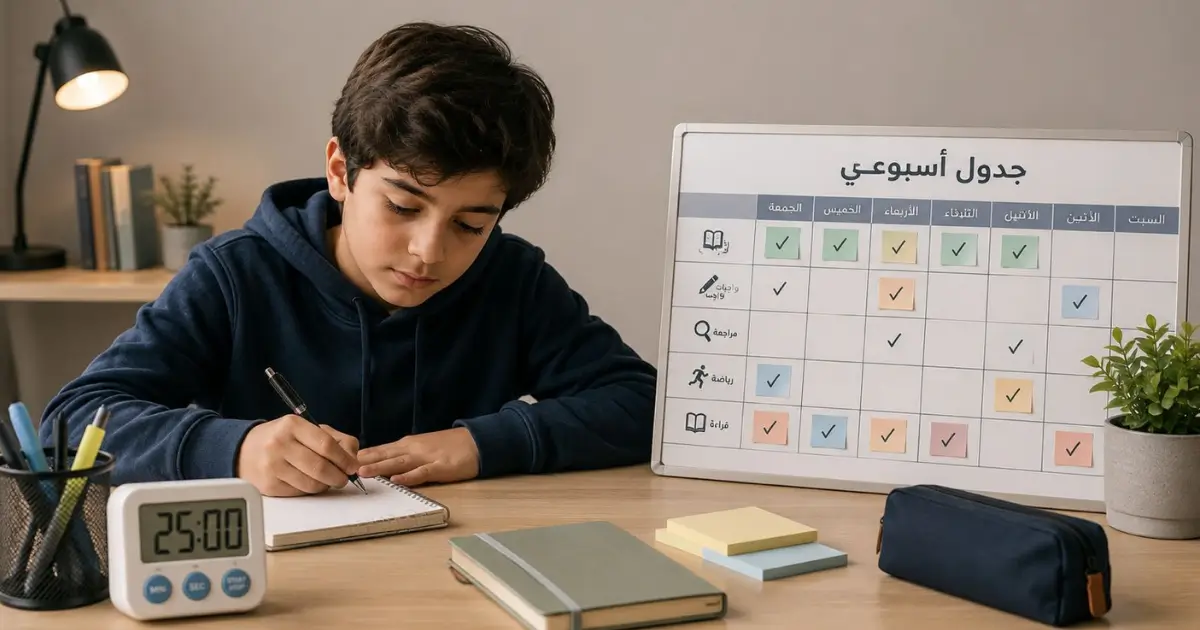
If your child is between 10 and 13 years old and wastes time on homework every day—starting then abandoning it, forgetting what’s required, being late until the last minute, or engaging in a long argument before opening their notebook—you’re likely going through one of the most perplexing phases for a mother.
They’re no longer a toddler who can be told, “Do this now.”
At the same time, they’re not old enough to manage their time and responsibilities entirely on their own.
You find yourself facing two difficult choices:
Either press it and remind it dozens of times.
Or you let him bear the consequences, and then you feel anxious and guilty.
But the truth is, organizing a child’s homework time (ages 10-13) isn’t achieved by yelling, nor by suddenly leaving the child alone. This stage requires a middle ground: a clear structure, gradual independence, small responsibilities, and tools that help the child see what’s required instead of feeling overwhelmed.
This guide gives you a practical understanding of what happens at ages 10-13, a clear plan for organizing homework time, reducing procrastination, and building confidence instead of turning studying into a daily battle.
A quick summary for the busy mom
If you don’t have time to read the entire article, here’s the main point:
Procrastination at ages 10-13 isn’t always laziness. Sometimes it’s difficulty starting, poor time management, fear of failure, distractibility, or feeling that the task is too big and the child doesn’t know where to begin.
Start with these rules:
- Don’t just say “Finish the homework”; help him identify the first step.
- Keep homework time consistent as much as possible.
- Divide the homework into three small blocks.
- Use a short timer: 15 minutes of work + 3 minutes of rest.
- Create a list of only three tasks per day.
- Give him gradual responsibility instead of constant monitoring.
- Praise commitment and initiative, not just the grade.
The goal isn’t to control his day.
The goal is to build a system with him that he can use even when you’re not around.
Why is Ages 10–13 a Different Stage?
At this age, a child begins to feel older. They want privacy, they want decision-making power, and they want to feel that their opinion matters.
But at the same time, they are still learning important skills such as:
- Time management.
- Prioritizing tasks.
- Starting tasks.
- Dividing homework.
- Resisting distractions.
- Taking responsibility.
- Frustration Management
- Finishing what you start.
So you might see him say,
“I know, don’t remind me.”
Then he doesn’t start.
Or he says,
“I’ll do it in a bit.”
Then he wastes time.
Or he starts the homework and then abandons it after 10 minutes.
This doesn’t mean he doesn’t always care. Sometimes it means he simply doesn’t yet have a clear system in place to help him get things done.
Why does a child waste time on homework at ages 10-13?
1- He doesn’t know where to begin
He doesn’t know where to begin.
The word “homework” might seem overwhelming and vague to him.
He sees books, notebooks, materials, questions, an upcoming exam, and a letter from the school. He feels that starting is difficult.
Instead of beginning, he avoids it.
The solution here isn’t pressure, but rather minimizing the initial steps.
“Just open the notebook.”
“Just write the date.”
“Just answer the first question.”
“Just read the first paragraph.”
A small start breaks the fear of the task.
2- The homework has become longer than before
In the early stages, tasks are often straightforward and short.
But between the ages of 10 and 13, tasks begin to become longer and more complex.
The task might be:
- Short research project.
- Review the lesson.
- Memorize the material.
- Solve problems.
- Prepare a project.
- Read a text.
- Prepare for a test.
If the child doesn’t learn how to chunk tasks, they will feel that everything is required all at once.
3- The distractors are stronger
Phones, games, videos, messages, notifications, and boredom all make homework seem heavier.
We don’t need to ban everything outright.
What we need is a clear plan:
Short time for homework.
Then a break.
Then a reward or activity.
A clear system is better than a daily battle.
4- Fear of failure
Some children procrastinate not because they don’t care, but because they are afraid.
They might think:
“I won’t understand.”
“I’ll make a mistake.”
“My mother will be angry.”
“The teacher will scold me.”
“I’m not good.”
In this case, procrastination becomes a defense mechanism against the feeling of failure.
Therefore, we start with the easiest task, praise the effort, and minimize harsh judgment.
5- Lack of a consistent routine
If homework is done at a different time, in a different place, and in a different way each day, getting started becomes more difficult.
The child needs to know:
When do I start?
Where do I sit?
What’s the first step?
How much work will I do?
When do I rest?
What happens after completion?
The clearer the system, the less argument there will be.
When is Delaying normal? And when do we need a clearer plan?
Delaying may be normal if:
- It only happens occasionally.
- It increases with exam time or fatigue.
- It improves when we set a clear schedule.
- The child can achieve results when they start.
- It doesn’t significantly affect school performance or confidence.
But we need a clearer plan if:
- Procrastination is a daily occurrence.
- Homework becomes a constant source of conflict.
- Grades are starting to drop.
- The child speaks negatively about their abilities.
- They frequently forget their assignments.
- They don’t know how to organize their bag or books.
- They are easily distracted.
- They need constant supervision to accomplish anything.
- They experience noticeable anxiety before school.
- This is affecting their sleep or relationships at home.
In this case, we don’t need more scolding.
We need a simpler system and gradual training in responsibility.
A stress-free homework time management plan
Step 1: 10-minute agreement session
Don’t start the plan when you’re angry or right before the task.
Choose a calm time and say,
“I don’t want to pressure you every day. I want us to create a system that helps you get things done without yelling.”
Then ask him:
- What wastes your time the most?
- What subject is the most difficult?
- When do you prefer to start?
- What place helps you focus?
- What do you want to achieve after you’ve accomplished it?
The idea is for him to feel that the system is with him, not against him.
Step 2: Set a clear time for homework
Example:
From 5:00 to 5:45.
Or from 6:00 to 6:30.
Or one hour after lunch.
The time shouldn’t be too long.
The most important thing is that it’s predictable.
When a child knows that homework has a fixed time, there’s less negotiation.
Step 3: Start with the smallest part
Golden rule:
Don’t start with “Finish all the homework.”
Start with “The first 10 minutes.”
Say:
“Now all that’s required is for you to start for 10 minutes. After that, we’ll decide on the next step.”
Often the hardest part is getting started.
Once you begin, finishing becomes easier.
Step 4: Divide the assignment into 3 blocks
Use a simple sheet of paper:
- Easiest.
- Medium.
- The Hardest.
Start with the easiest to boost motivation.
Example:
- Read question one.
- Complete two exercises.
- Review the difficult part.
This helps the child see that the task isn’t a huge chore.
Step 5: Use the work and rest timer
A suitable schedule for this age:
15 minutes of focus.
3 minutes of rest.
Then another 15 minutes.
The time can be adjusted according to the child:
10 minutes for a child who is easily distracted.
20 minutes for a child who can concentrate better.
The important thing is that the break is short and focused, and doesn’t turn into a screen-time activity.
Step 6: List only 3 tasks
Don’t make a long list.
Write:
- Essential homework
- Packing the Bag
- Preparing Tomorrow’s Clothes
Three tasks are enough to start with.
A child who gets overwhelmed by too many tasks needs a list that works, not a perfect list that fails.
Step 7: Gradually hand over responsibility
Instead of reminding him 20 times, agree with him:
“I’ll remind you once when it’s time for homework. After that, the timer and the list will help.”
At first, you might need close monitoring.
But the goal is to gradually reduce the monitoring.
Step 8: A clear reward after commitment
A reward isn’t a bribe if it’s part of a consistent system.
Example:
If he completes his assignment on time, he gets 20 minutes of an activity he enjoys.
If he doesn’t, the activity is postponed until after completion.
No yelling.
No lengthy threats.
Just a consistent rule.
If you’re looking for a ready-made system to help your child confidently manage their time, check out the Routine and Organization Box 10-13.
The box provides a plan, tools, printed exercises, and a tracking system suitable for this age group.
Practical tools suitable for ages 10–13
1- 15-Minute Challenge
Make Focus a Points Game:
15 minutes of focus = 1 point.
3 points per day = choose a simple activity.
The goal is for the child to feel that achievement is measurable.
2- “What’s the First Step?” Sheet
Before each task, the child writes:
- What’s required?
- What’s the first step?
- How many minutes do I need?
- What do I do if I get stuck?
This sheet helps children who get lost before they even begin.
3- 5-Minute Weekly Plan
Once a week, write down the following with him:
- Three important tasks this week.
- The day of each task.
- An approximate time.
- A small reward upon completion.
- Don’t make the plan complicated.
A simple plan that is followed is better than a beautiful plan that is abandoned.
4- Distractor Box
During homework time, put your phone or small toys in a box far away.
Say:
“This isn’t confiscation. This is a short focus period, and then things can be returned.”
The language of cooperation is better than the language of punishment.
5- “I Need Help” Card
Some children don’t ask for help until they’re on the verge of a breakdown.
Use a simple card:
- “I need an explanation of the question.”
- “I need a break.”
- “I need to start with you.”
- “I just need you to read what’s required.”
This method reduces screaming and withdrawal.
Common mistakes that increase procrastination
Mistake 1: Constant monitoring
Standing over your child’s head can make them more dependent or defiant.
Be close at first, but gradually reduce your involvement.
Mistake 2: Daily threats
Threats might motivate a child momentarily, but they don’t build organizational skills.
A clear system, a clear reward, and a consistent outcome are best.
Mistake 3: Comparison
“Your brother gets things done faster.”
“Your colleague is better than you.”
These statements undermine confidence and don’t teach skills.
Replace them with:
“I started faster today than yesterday.”
“I liked that you divided the task.”
“That’s a good move.”
Mistake 4: Too Long a List
If you list 10 tasks, he might not even start on any of them.
Start with just three tasks.
Mistake 5: Neglecting sleep and rest
If procrastination becomes a daily source of stress, start with a clear plan instead of repeating the same discussion every day.
When is a routine and organization box helpful for ages 10-13?
The box might be suitable if your child:
- He procrastinates on homework.
- He wastes time.
- He doesn’t know where to begin.
- He forgets to pack his bag.
- He gets stressed when studying.
- He needs a simple schedule.
- He needs to build confidence and responsibility.
- He is easily distracted.
- He needs visual aids, not just instructions.
The box does not offer a “magic solution,” but it does give mother and child a clear system: steps, exercises, follow-up, and short, actionable sessions.
Important Professional Clarification
Play Therapy Box provides educational and behavioral support to develop a child’s skills at home. It is not a medical diagnosis or a substitute for psychological treatment or medical follow-up when needed.
If a child is experiencing severe anxiety, clear learning difficulties, significant distractibility, or a significant decline in performance, it is best to consult a qualified professional.
Summary
Organizing a child’s homework time (10-13) doesn’t mean leaving them alone, nor does it mean monitoring them constantly.
The best approach is:
- A calm agreement.
- A fixed timeframe.
- A small start.
- Dividing the workload.
- A short timer.
- A list of 3 tasks.
- Gradual responsibility.
- A clear reward.
- Follow-up without shouting.
- Requesting a specialist if the difficulty is severe or persistent.
Ready to ease the pressure of homework and build a consistent routine?
Check out our Routine and Organization Box 10–13 and start small today.
FAQ
Sometimes it might seem normal, especially with increased homework. But it needs a plan if it becomes a daily occurrence or affects studies, confidence, and relationships at home.
Not suddenly. It’s best to gradually hand over responsibility: one reminder, a clear list, a timer, and then calm follow-up.
Begin with the smallest step possible: opening the notebook, writing the date, or answering one question. Small starts reduce resistance.
No, if it’s part of a consistent and clear system. The reward here helps the child associate commitment with a positive outcome, and it’s not a substitute for skill development.
Yes, sometimes. A distracted child may not know how to start or finish, so they need a structured, timed approach and a less distracting environment.
It varies from child to child, but a small improvement can be observed within two to four weeks if the system is consistent and appropriate.
Yes, if the tools are designed in a non-childish way and promote organization, responsibility, and confidence.
If the delay is significant, or accompanied by obvious anxiety, declining academic performance, severe distractibility, or a complete and repeated refusal to study, it is best to consult a professional.


