
One of the most honest questions a mother asks before starting any plan is:
“When will I see results?”
“Will my child change quickly?”
“Is 10 days enough?”
“What if I try it and nothing changes?”
This is a perfectly natural question, because a mother isn’t just buying a box. She’s investing hope, time, effort, and a fresh start after a long period of hard work.
But more important than the question, “When will I see results from modifying my child’s behavior?” is another question:
How do I know I’m on the right track?
What does real improvement look like?
Does improvement mean the problem disappears completely, or just the appearance of small signs first?
This article gives you realistic expectations and helps you measure your child’s progress simply, without making unrealistic promises or getting discouraged if there isn’t a dramatic change from day one.
Quick summary
We don’t promise that your child will change in two days.
Nor that the problem will disappear completely in 10 days.
However, within 7–10 days of consistent application, you may notice minor signs such as:
- Reduced tantrum duration.
- Easier acceptance of initiating activities.
- Sitting for a minute or two longer.
- Less repetition of instructions.
- Easier transition from one activity to another.
- Use of a calming agent only once.
- Less conflict in a given situation.
- Improved ability to initiate.
These aren’t “dramatic” changes, but they’re very important because they mean the skill is starting to move.
Real improvement often starts small.
Then it grows with practice.
Why Do Results Vary from One Child to Another?
No two children change at the exact same pace.
Results differ based on:
- The child’s age.
- The severity of the problem.
- How long the behavior has existed.
- Sleep patterns.
- The stress level at home.
- The presence of sensory difficulties, distraction, or impulsivity.
- The consistency of implementation.
- The timing of the activity.
- Choosing the right box.
- The way the mother introduces the activity.
- Whether the problem appears only at home or at school as well.
Therefore, it is unrealistic to say:
“All children improve at the same time and in the same way.”
The better way is to say:
“We measure small indicators, and we adjust the plan according to the child’s response.”
Why does the result sometimes not appear quickly?
1- Because skills require repetition
A child doesn’t learn to focus or calm themselves down in one go.
Just as they need repetition to learn to read or ride a bike, they need repetition to learn:
- Waiting.
- Focusing.
- Regulating emotions.
- Initiating / Starting tasks.
- Following instructions.
- Accepting loss.
2- Because the beginning can be difficult
The first two days may simply be an introduction to the activity.
The child may refuse.
They may try and then give up.
They may observe the mother before participating.
This doesn’t mean the plan has failed.
Sometimes it simply means the child needs a gentler approach.
3- Because the root problem might be different
Sometimes a mother thinks the problem is focus, while the root cause is sensory regulation.
Or she thinks it is stubbornness, while the child is afraid of failure.
Or she thinks it is laziness, while the child simply does not know how to start.
If we start with an unsuitable skill, results may appear slow.
This is why assessment is important: it helps choose the starting point closest to the child’s actual need.
4- Because the mother only measures the big result
If the mother is waiting for the problem to disappear completely, she might not notice small improvements.
Example:
Before the plan: The tantrum lasted 20 minutes.
After a week: It became 12 minutes.
This is an important result, even if the tantrum didn’t disappear.
What to expect in 10 days?
Over 10 days, we’re not aiming for perfection.
We’re looking for indicators.
Days 1-2: Accepting the Start
Goal:
- The child becomes familiar with the activity.
- Their initial fear decreases.
- The mother accepts the routine.
- We determine if the activity is appropriate or challenging.
Significant improvement may not be apparent yet.
Days 3–5: Small Response
We might notice:
- The child starts more quickly.
- They accept short activities.
- They need fewer reminders.
- They sit for a minute longer.
- They refuse a little less.
- They laugh or react to a particular activity.
Days 6–8: Repetition and Consistency
Here we begin to see if the skill is repeated:
- Does he regain focus after being distracted?
- Does he accept being moved around?
- Does he use a phrase or a card?
- Does he respond to a calming agent?
- Does he experience less conflict in one particular situation?
Days 9–10: Evaluation and Adjustment
At the end of 10 days, we ask:
- What worked?
- What was difficult?
- Is the activity age-appropriate?
- Do we need to simplify it?
- Do we need a different box?
- Do we need additional support?
The 10-day plan is not the end of the journey.
It is the beginning of an organization that helps us know the direction.
If you want the right start for your child from the very beginning, start with the free trial.
It will recommend the most suitable box or package for your child’s age and needs.
Simple indicators to measure progress
You don’t need a complicated schedule.
Choose just two indicators for 10 days.
Indicator 1: Duration of the problem
Ask yourself:
- How many minutes does the tantrum last?
- How many minutes can they stay focused?
- How long does it take them to start their homework?
- How long does the transition from screen time to bedtime take?
If the duration decreases even slightly, that’s progress.
Indicator 2: number of repetitions
Ask yourself:
- How many times do I repeat the instructions?
- How often does he abandon the activity?
- How often does a conflict occur?
- How often does he refuse to start?
If the number decreases from 6 to 4, this is progress.
Indicator 3: Response speed
Ask yourself:
- Did he start after one reminder instead of five?
- Did he calm down faster?
- Did he accept both options?
- Did he return after the break?
Response speed is a very important indicator.
Indicator 4: Relationship quality
Not all progress is numerical.
Observe:
- Is there less shouting?
- Is the house a little quieter?
- Is activity time less intense?
- Is the relationship less strained?
- Is the child resisting less?
An improved relationship is an important part of the outcome.
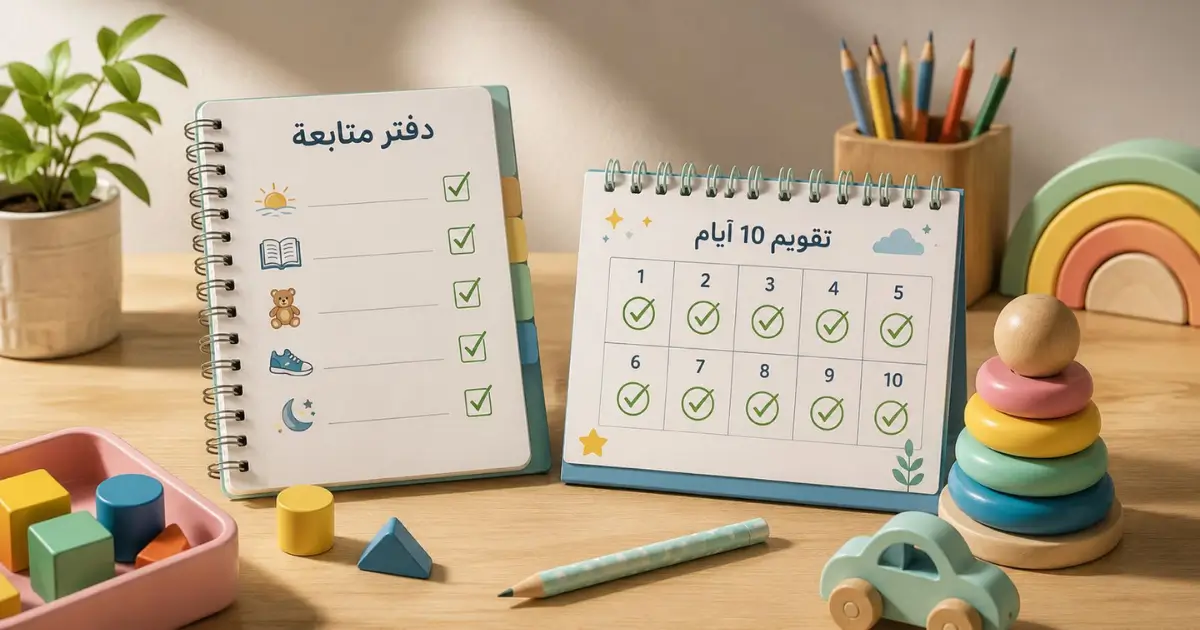
Simple 10-day follow-up form
Use this template:
Today:
Skill we are focusing on:
Activity used:
Activity duration:
How did the child begin?
- Refused
- Hesitated
- Began with help
- Began easily
What did you notice?
- Sit longer
- Calm down faster
- Refused less
- Leave the activity
- Needed simplification
- Enjoyed
Today’s rating from 1 to 5:
A small note for tomorrow:
Don’t write too much.
One minute is enough.
Mistakes that make a mother feel like “there’s no result”
Mistake 1: Starting with too many skills at once
Today it’s focus.
Tomorrow it’s feelings.
Then it’s routine.
Then it’s social.
This distracts both the child and the mother.
Start with one skill for 10 days.
Mistake 2: changing the activity every day
Skills require repetition.
If we change the activity daily, we won’t know what worked.
Mistake 3: Expecting a Total Change
Do not expect the child to become completely calm.
Watch for the small improvements.
Mistake 4: Sporadic application
Once a day, then forget about it for a week, then come back.
A short daily session is better than one long session.
Mistake 5: Choosing an unsuitable box
If a child needs sensory organization and we start with only focus tools, the result may be slower.
Mistake 6: Starting at the wrong time
If a child is hungry, tired, or overstimulated, they will refuse the activity even if it is appropriate.
So that you don’t waste your time with random experiments, the test will determine the most suitable starting point for you within a minute.
How do I know that I have chosen the right starting point?
A good start is likely if, within 7–10 days, you notice:
- Greater acceptance of the activity.
- Less resistance.
- Less conflict.
- Faster start.
- Easier calming down.
- Better commitment to small steps.
- Minimal focus on the tool.
- Greater ability to recover after distraction.
If you don’t notice any difference, it doesn’t always mean the child isn’t benefiting.
It could mean the plan needs adjusting.
- The activity is difficult.
- The timing is inconvenient.
- The underlying problem is different.
- The child needs an easier approach.
- The mother needs a different presentation.
- The situation requires a specialist if it is severe.
When do we need additional support?
Consult a specialist if:
- The problem is very severe.
- It affects school, sleep, and eating.
- There are unsafe behaviors.
- The child is not improving despite the plan being followed consistently.
- There are difficulties with communication or clear language.
- Anxiety or withdrawal is severe.
- The family is constantly stressed because of the behavior.
The box is a home support tool, but it is not a substitute for professional assessment when needed.
Important Professional Clarification
Play Therapy Box provides educational and behavioral support for developing a child’s skills at home. It is not a medical diagnosis, nor is it a substitute for psychotherapy, occupational therapy, or medical follow-up when needed.
We do not promise that every child will achieve the same results at the same time.
The goal is to build skills gradually and measure progress realistically.
Summary
The question, “When will the results of modifying a child’s behavior become apparent?” is important.
But what’s even more important is knowing how to measure the outcome.
Don’t wait for a miracle.
Observe the small indicators:
- Less time.
- Less frequency.
- Faster response.
- Less conflict.
- A calmer relationship.
- Easier start.
If these signs appear, you are most likely on the right track.
Start now and get your recommendation in a minute.
A simple, free test will recommend the most suitable box or package for your child’s age and needs.
FAQ
No. Two days is too short a time. We often look for small indicators over 7–10 days, such as better acceptance or less conflict.
Review the timing, the difficulty of the activity, the consistency of the application, and whether the box is appropriate for the underlying problem. Sometimes we need to simplify the beginning.
Yes. Children aged 3–6 need short, visual games, while children aged 10–13 need more organizational and responsible activities.
It’s a good starting point for observation and reinforcement, but it’s not the end of the training process. Skills require consistency and repetition.
Yes, the test is free and helps you choose the most suitable starting point for your child’s age and needs.


