
Currently Empty: $0.00

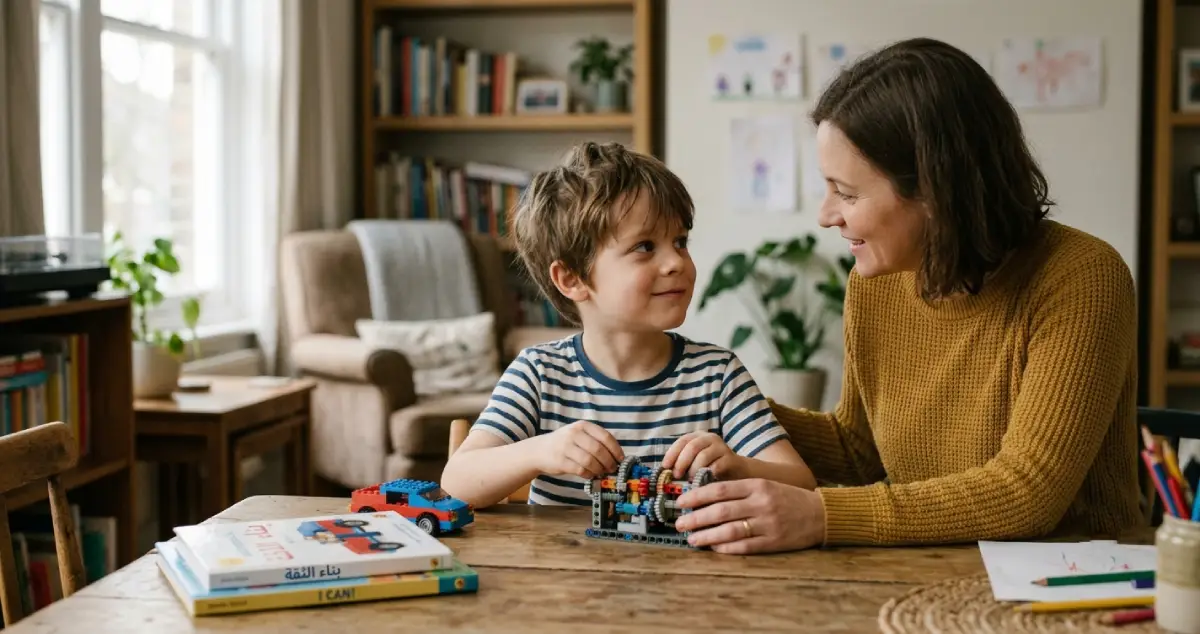
If your child often says things like:
“I can’t do it.”
“It’s too hard.”
“I don’t know.”
“I don’t want to try.”
Or they start a task and give up after a few minutes, it’s easy to think they’re being lazy, stubborn, or simply don’t want to make an effort.
But in many cases, that’s not the real problem.
Your child may be afraid of failing, sensitive to criticism, used to expecting quick success, or they simply haven’t had enough experiences that taught them, “I can keep trying and get better.”
Building a child’s self-confidence doesn’t happen just because we say, “You’re strong” or “You’re smart.”
Confidence grows through small, repeated experiences where a child tries, makes mistakes, adjusts, and eventually succeeds—even if it’s only a small step.
This article will help you understand why children say, “I can’t do it,” and show you practical, gentle ways to build their confidence at home through simple activities and games that give them a real sense of achievement without pressure.
A Quick Summary for Busy Moms
If you don’t have time to read the whole article, here’s the key takeaway:
A child who keeps saying, “I can’t do it,” usually doesn’t need more pressure.
What they really need is small, repeated successes, specific praise, and a safe space where it’s okay to make mistakes.
Start with these simple rules:
- Choose tasks your child is likely to succeed at.
- Break every task into the smallest possible step.
- Praise the effort and the attempt, not just the result.
- Avoid comparing your child to siblings or classmates.
- Don’t rush to do the task for them.
- Treat mistakes as a normal part of learning.
- Create a short daily “success routine” they can stick to.
The goal isn’t for your child to become confident overnight.
The goal is to help them experience a new feeling:
“I can give it a try.”
Why Does Your Child Say, “I Can’t Do It”?
When a child says, “I can’t do it,” it may sound like they’re refusing, but those words often hide a lot of different feelings.
They might actually mean:
- I’m afraid I’ll fail.
- I don’t want anyone to laugh at me.
- I don’t know where to start.
- This feels too big for me.
- I tried before and it didn’t work.
- I don’t want you to be upset with me.
- I need help, but I don’t know how to ask for it.
- If I don’t try, I won’t have to find out that I can’t do it.
That’s why the first step isn’t to argue with them.
Instead of saying, “Of course you can. Don’t say that,” try to understand what’s really behind those words.
You can calmly say:
- “It looks like this feels really hard for you.”
- “Let’s start with the smallest part.”
- “You don’t have to get it right the first time.”
- “I’m here to help you, but I won’t do it for you.”
What Causes Low Self-Confidence in Children?
1. Fear of Failure
Some children would rather not try at all than risk trying and failing.
Avoiding the task protects them from feeling embarrassed or disappointed.
What they need to learn is that making mistakes doesn’t mean they’ve failed—it simply means they’re learning.
2. Constant Criticism, Even with Good Intentions
Sometimes parents say things like:
- “No, not like that.”
- “You always rush.”
- “Pay more attention.”
- “Why don’t you understand?”
Even if the intention is to help, the child may hear a completely different message:
“I’m not good at anything.”
That’s why it’s important to criticize less and guide more.
3. Comparing Them to Others
Comparison can quickly damage a child’s confidence.
Comments like:
- “Your brother finishes much faster.”
- “Your friend is better than you.”
- “Kids your age already know this.”
don’t create real motivation.
Instead, compare your child to their own progress:
- “You tried harder today than you did yesterday.”
- “You got started more quickly this time.”
- “I liked that you didn’t give up right away.”
4. Tasks That Are Too Difficult
If a task feels far beyond a child’s ability, they’ll expect to fail before they even begin.
Instead of saying, “Clean your room,” try saying:
“Let’s put away just five things.”
Instead of:
“Write the whole page,”
say:
“Just write the first line.”
Confidence grows when success feels achievable.
5. Depending Too Much on Mom
Sometimes, out of love or because it’s faster, a parent ends up doing everything for the child.
Getting them dressed, cleaning up for them, solving problems for them, or starting every task on their behalf.
Over time, the child may begin to believe:
“I can’t do things on my own.”
Helping your child is important, but your support should be a bridge toward independence—not a replacement for it.
When Is Low Self-Confidence Normal, and When Does Your Child Need More Support?
Low confidence can be completely normal if it:
- Only shows up when your child is trying something new.
- Happens when they’re tired or under stress.
- Improves with encouragement.
- Gets better once the task is broken into smaller steps.
- Doesn’t have a big impact on their daily life.
However, it’s time for a more structured plan if your child:
- Gives up on most tasks.
- Refuses to try, even with simple activities.
- Regularly says negative things about themselves.
- Avoids school or activities because they’re afraid of making mistakes.
- Gets very upset over even small corrections.
- Refuses to try anything new.
- Depends on you for every single step.
- Struggles socially or academically because of their fear of failure.
If these negative statements are frequent and intense, or they’re accompanied by clear signs of anxiety or withdrawal, it’s a good idea to speak with a qualified child development or mental health professional.
A Simple Daily Plan to Build Your Child’s Confidence
Step 1: Follow the 80% Success Rule
Start with tasks your child is very likely to succeed at.
The goal isn’t to test them.
The goal is to give them the experience of success.
Examples:
- Put away 5 toys.
- Read one line.
- Answer one question.
- Put together 3 puzzle pieces.
- Pick a flashcard and name it.
- Write one word.
- Pack their school bag with your help.
When children experience success, they’re much more willing to try the next challenge.
Step 2: Break Every Task Into Tiny Steps
Big tasks can feel overwhelming.
Instead of saying:
“Clean your room.”
Try:
“Let’s put the toy cars in the box first.”
Instead of:
“Finish your homework.”
Say:
“Open your notebook and write today’s date.”
Instead of:
“Read the story.”
Say:
“Let’s read the first sentence.”
After they finish that first step, say:
“That was a great start. What’s the next small step?”
Step 3: Praise the Effort, Not Just the Outcome
General praise like “Good job!” is nice, but it isn’t enough.
Be specific instead:
- “I like that you kept trying even though it was hard.”
- “I noticed you came back and finished after taking a break.”
- “I’m glad you asked for help instead of giving up.”
- “I like that you tried a different way.”
- “That’s what persistence looks like.”
Specific praise helps children understand exactly what they did well, making them more likely to do it again.
Step 4: Make Mistakes Feel Safe
Before starting an activity, remind your child:
- “It’s okay to make mistakes.”
- “Mistakes help us learn what to do differently.”
- “This isn’t a test.”
- “We’ll try once, then make changes if we need to.”
If they make a mistake, don’t rush to correct them.
Instead, ask:
- “Which part do you think we should fix?”
- “Should we try an easier way?”
- “Would you like a little help to get started?”
Step 5: Don’t Do the Task for Them
If your child gets stuck, help only with the beginning.
For example:
“I’ll help you with the first step, then you can do the next one.”
Or:
“I’ll hold the paper while you write the word.”
Or:
“I’ll break the task into smaller parts, and you choose where to start.”
Good support tells a child:
“You can do this—I’m just here to help.”
Step 6: Create a 10-Minute Daily Success Routine
Pick the same time every day.
Keep the routine simple:
- A small task.
- A chance to try.
- Specific praise.
- A sticker, checkmark, or another small sign of success.
- End on a positive note.
Don’t make the routine too long.
Ten minutes is more than enough to get started.
If your child gives up easily and you’re looking for a clear place to start, take our free quiz.
Based on your child’s age and individual needs, we’ll recommend the most suitable box or bundle—whether they need support with confidence, emotional skills, focus, or social skills.
Simple Home Games to Build Your Child’s Confidence
Game 1: The 3 Success Challenge
Write down three very simple tasks, such as:
- Put away 5 toys.
- Draw a circle.
- Pick a flashcard.
- Name a color.
- Read one word.
- Put 3 things back where they belong.
Each completed task earns a check mark.
At the end, say:
“See? You finished three things today!”
The goal is to help your child clearly see their own success.
Game 2: I Can Do It… Then a Little More
Choose one activity and increase the challenge little by little.
Today: Complete a 3-piece puzzle.
Tomorrow: Complete a 4-piece puzzle.
The next day: Try a 5-piece puzzle.
Say:
“You’re getting better step by step.”
This teaches children that their abilities grow with practice.
Game 3: The “I’ll Try Once” Card
Make a small card that says:
“I’ll try one time.”
Whenever your child says, “I can’t do it,” hand them the card.
Then say:
“You don’t have to get it right. You only need to give it one try.”
This helps take the pressure off and makes trying feel much less scary.
Game 4: The Success Box
Write every small achievement on a piece of paper and place it in a box.
For example:
- “I tried reading.”
- “I put away 5 toys.”
- “I asked for help.”
- “I kept going even though it was hard.”
At the end of the week, open the box together and read all the notes.
It’s a simple way to remind your child how much they’ve accomplished.
Game 5: What Did We Learn from the Mistake?
After a small mistake, ask questions like:
- “What did we learn?”
- “What can we do differently next time?”
The goal is to help your child see mistakes as part of learning—not as proof that they aren’t capable.
Common Mistakes That Weaken a Child’s Self-Confidence
Mistake 1: Comparison
Comparison makes a child feel like they are always behind.
Instead, focus on their own personal progress.
Mistake 2: Overpraising
Saying things like “You’re the best in the world” may sound nice, but it can sometimes pressure the child to maintain a perfect image.
A better approach is:
- “I like your effort.”
- “I like that you tried.”
- “I like that you changed your approach.”
Mistake 3: Rescuing Them Too Quickly
If you always do the task for them, they won’t get the chance to discover what they can do on their own.
Support them, but don’t take the experience away from them.
Mistake 4: Turning Everything Into a Test
A child who feels they are constantly being evaluated may become afraid of trying.
Make sure some activities are simply for learning and fun, with no pressure.
Mistake 5: Focusing Only on Results
Grades matter, but effort and strategy matter more when it comes to building long-term confidence.
If you want a clear plan instead of random attempts, start with the quiz.
It will help identify the most suitable path for your child’s age and needs in just one minute.
When Does the Confidence Box Help?
It may be suitable if your child:
- Often says “I can’t do it.”
- Refuses to try.
- Is afraid of making mistakes.
- Gives up quickly.
- Avoids new tasks.
- Needs frequent small wins.
- Is sensitive to criticism and comparison.
- Needs activities that build a sense of capability.
The box helps because it turns confidence into practical training: short activities, clear steps, visible achievements, and guidance for parents.
Important Professional Note
The Play Therapy Box provides educational and behavioral support to develop a child’s skills at home. It is not a medical diagnosis tool and is not a replacement for psychological therapy or medical follow-up when needed.
If a child shows severe anxiety, clear withdrawal, or repeated negative self-statements, it is best to consult a qualified specialist.
Summary
Building a child’s confidence does not start with pressure or comparison.
It starts with small experiences that tell them:
“I can try, I can learn, and I can improve.”
Start today with:
- A simple task
- A small step
- Specific praise
- A safe space for mistakes
- A short daily achievement
- Gentle, low-pressure follow-up
Start now and get your recommendation in just one minute.
A simple free quiz that suggests the most suitable box or bundle based on your child’s age and needs.
FAQs
Does low self-confidence mean my child is very sensitive?
A child may be sensitive to criticism or fear of failure, but what matters most is building their confidence gradually through small achievements instead of pressure.
What should I do if my child says, “I can’t do it”?
Don’t get into a long argument. Break the task into a very small step, ask for just one attempt, then clearly praise the effort.
Does praise help build confidence?
Yes—if it is specific praise focused on effort, trying, and strategies, not general exaggeration or focusing only on intelligence.
Does poor concentration affect confidence?
Yes. A child who gets easily distracted may feel unsuccessful. Supporting focus and breaking tasks into smaller steps also helps build confidence.
When should I consult a specialist?
If your child consistently refuses to try, speaks about themselves in very negative ways, or withdraws from activities and school, it is best to seek help from a qualified professional.
Suggested Trusted External Resources



