One of the most common questions mothers ask before buying a Play Therapy Box is:
“Are these just toys?”
“Why can’t I just buy educational toys from a store?”
“What’s the difference between a pretty toy and a play therapy box?”
“Can play really help my child?”
These are very logical questions.
The market is flooded with toys labeled with buzzwords like “educational” ,”skill development”, “intelligence”, “Montessori”, “focus”, or “child development”. However, the problem is that the toy alone is not always enough. A child does not just need a tool; they need a method of use, a clear objective, a gradual learning curve, and age-appropriate repetition.
The real difference between a regular toy and therapeutic toys for children in an organized box isn’t just in the toy’s appearance. The difference lies in:
The goal, the plan, the progression, the method of implementation, and the mother’s role during play.
This article explains the difference in a simple way, so you know why the Play Therapy Box was designed as a home system for developing skills, and not just a collection of toys inside a box.
Quick Summary
A regular game can be fun and generally beneficial.
However, a structured therapy box differs because it links each tool to a clear skill-based objective.
The key difference:
Regular play: An open-ended activity that the child may use or abandon.
Organized box: A tool + guide + implementation plan + progression + follow-up
Regular play: The mother may not know how to use it.
Organized box: Provides the mother with clear steps.
Regular play: Not always related to the child’s problem.
Organized box: Chooses the starting point based on age and need.
The game itself is not the problem.
The problem is that a game without a plan can become something new that the child will boredof after a couple of days.
Why does the mother ask: Are they just toys?
Because many mothers have tried buying many toys before.
They bought concentration toys.
Brain games.
Cards.
Building blocks.
Activity books.
Sensory toys.
Educational toys.
But after a while, she felt that the problem hadn’t changed much.
Why?
Because the question isn’t, “Is the game good?”
The more accurate question is:
Is this game age-appropriate for my child?
Does it address their underlying problem?
Do I know how to begin with it?
Is there a gradual progression?
Do I know how to measure progress?
Do I know what to do if my child refuses the activity?
Do I know when to increase the difficulty and when to make it easier?
This is where the difference lies between buying a random game and following a structured play plan.
What is the difference between regular play and therapeutic play for children?
Regular Play
A regular game may be fun and enjoyable, and may generally help a child, but it often lacks:
- A specific skill-based objective.
- A clear implementation plan.
- A gradual approach based on age.
- Guidance for the parent.
- Monitoring indicators.
- Alternatives if the child refuses.
- An explanation of why we are using this activity.
- A connection to the underlying problem, such as distractibility, anger, or routine.
Example: A memory card game might be helpful, but a mother might not know:
How many minutes should I use it for?
Should I start with 4 cards or 12?
Is it suitable for ages 3-6 or 7-9?
What should I do if my child gets upset when they make a mistake?
Does this game improve focus, memory, or waiting one’s turn?
How will I know if my child has improved?
Therapeutic toys inside an organizer box
Therapeutic toys for children, when placed in a structured box, don’t mean the toy itself “treats” on its own.
They are used within a plan to develop a specific skill.
Examples:
- A toy to train short-term focus.
- An activity to name emotions.
- A card to practice waiting in line.
- An exercise to reduce impulsivity.
- A sensory tool for body regulating.
- A picture chart to support routines.
- An achievement game to build confidence.
Here, the toy becomes a training tool, not just entertainment.
Why isn’t the toy alone enough?
Because a child doesn’t develop a skill simply by possessing a tool.
For example:
Owning a pen doesn’t mean a child has learned to write.
Owning a book doesn’t mean a child has learned to read.
Owning a concentration toy doesn’t mean a child has learned to pay attention.
A skill requires:
- An easy start.
- Repetition.
- Gradual progression.
- Provide appropriate praise.
- A suitable environment.
- Follow-up.
- A method for handling rejection or anger.
- Linking the game to everyday behavior.
Therefore, Play Therapy Box doesn’t just sell a “toy,” but offers an application method that helps the mother know: What should I do today? What should I monitor? And how can I start without pressure?
What is usually inside the box?
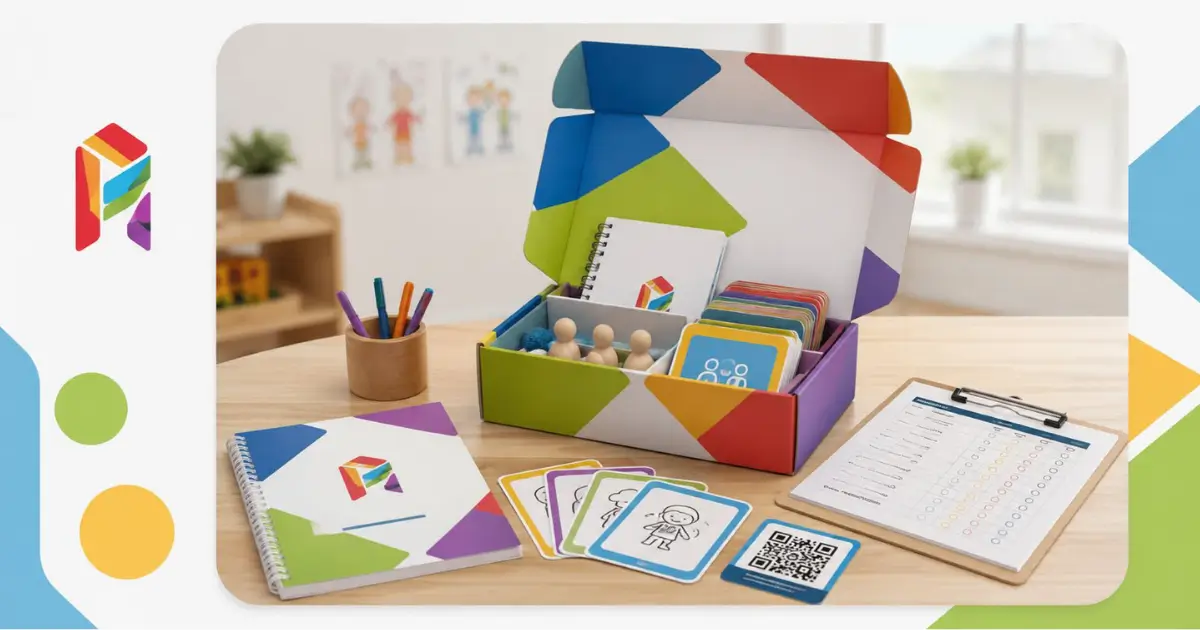
Depending on the type of box and the age group, the box may contain:
- Guided play tools.
- Printed exercises.
- Skill cards.
- User guide for mothers.
- 10-day implementation plan.
- QR code for instructional video.
- Progress tracking form.
- Short, age-appropriate activities.
- Suggestions for modifying activities if the child refuses.
- WhatsApp support.
- One guidance call, depending on the plan.
The value is not just in the number of pieces.
The true value lies in the fact that every single piece has a purpose and a specific way to be used.
How are the tools inside the box selected?
A tool isn’t chosen simply because it’s beautiful.
Nor because it’s popular.
Nor because it’s trending online.
A tool is chosen because it serves a specific skill.
We ask before introducing any tool:
- What skill does it serve?
- Is it age-appropriate?
- Can the mother implement it at home?
- Can it be used in a short amount of time?
- Can it be simplified or intensified?
- Does it help the child achieve a small accomplishment?
- Does it address the underlying problem?
- Can its impact be measured?
If a tool is beautiful but does not serve a clear purpose, it is not suitable as part of the package.
How does the 10-day plan work?
A 10-day plan is important because it prevents mothers from starting haphazardly.
Instead of asking yourself every day, “What should I try today?”
You have a clear path ahead.
Simplified example:
Days 1-2: Gentle Introduction
We start with a very easy activity so the child doesn’t resist.
The goal isn’t in-depth training, but rather acceptance of the initial stage.
Days 3-4: Reinforcing the Routine
We repeat the same time and method until the child feels secure.
Days 5–6: Slight Increase
We add one minute or a small step.
Days 7–8: Application in Everyday Situations
We connect the skill to something happening at home: chores, routines, anger, sharing.
Days 9–10: Follow-up and Reinforcement
We observe: What has improved? What needs simplifying? And what’s next?
The plan doesn’t promise a miracle in 10 days.
But it helps you see initial indicators and know if you’re on the right track.
If you want a clear choice instead of buying random toys, start with the free trial. It will recommend the most suitable box or package based on your child’s age and needs.
Why does it matter that the box is age-appropriate?
Because the same game might be very easy for one child and very difficult for another.
A child aged 3–6 needs:
- A short activity.
- Pictures.
- Action.
- One-step instructions.
- Quick success.
A child aged 7–9 needs:
- Short challenges.
- Temporarily.
- Two-step instructions.
- Focus training and routines.
A child aged 10–13 needs:
- Organizational tools.
- Gradual responsibility.
- Simple planning.
- A non-childish approach.
Teenagers aged 14–17 need:
- Smart tools.
- Privacy.
- Respectful language.
- Embarrassment-free support.
Therefore, age selection is not a detail; it is a fundamental part of the app’s success.
Mistakes of Buying Random Toys:
The first mistake: buying a game unrelated to the problem
If the core problem is emotional regulation, a memory toy alone may not be the right starting point.
And if the problem is sensory, a paper-based activity may not be sufficient.
The second mistake: Buying a toy that is too old for the child
A difficult game might make a child say, “I can’t.”
Then the mother might think the child isn’t cooperating.
The third mistake: changing the game every day
Skills require repetition.
If we change the tool every day, we don’t give the child a chance to build a habit.
The fourth mistake: expecting that the toy alone will change behavior.
The tool needs a specific presentation method.
The mother’s tone, timing, duration of the activity, and routine all have an effect.
The fifth mistake: not measuring progress
Without follow-up, you might not notice even small improvements.
For example:
- He sat a minute longer.
- Before the start of the activity.
- He refused less.
- He returned after being distracted.
- He named his feeling once.
These are important indicators.
To avoid wasting your time and money on toys that don’t meet your child’s needs, start by testing.
It will determine the most suitable starting point within a minute.
Do I need a diagnosis before using the box?
A diagnosis is not required to benefit from the fund, as the fund is designed to support everyday skills such as:
- Focus.
- Routine.
- Emotional regulation.
- Waiting one’s turn.
- Self-confidence.
- Impulsiveness.
- Sensory regulation.
- Cooperation with activities.
However, if the child has severe difficulties, a previous diagnosis, or obvious problems at school, in communication, or with safety, it is best to consult a specialist.
When is the box appropriate?
It might be appropriate if you were saying:
- I don’t know where to begin.
- I’ve bought so many toys, but they haven’t helped.
- My child refuses to do activities.
- I need a plan in place.
- I want something age-appropriate.
- I need tools with instructions.
- I need a way to track his progress.
- I need support if he doesn’t cooperate.
Important Professional Clarification
Play Therapy Box provides educational and behavioral support for developing a child’s skills at home. It is not a medical diagnosis, nor is it a substitute for psychotherapy, occupational therapy, or medical follow-up when needed.
Play is a tool for skill development, not a promise of a cure or a guaranteed outcome for every child using the same method.
Summary
Therapeutic toys for children are not “magic,” but they’re not just ordinary games either.
The real difference is:
- Clear skill objective.
- Age-appropriate selection.
- Implementation plan.
- Gradual progression.
- Guide for mothers.
- Progress monitoring.
- Support when needed.
If a mother has a toy without a plan, she’ll often feel like she’s just experimenting randomly.
But when she has a tool with a system, the path becomes clearer and easier.
Start now and get your recommendation in a minute.
A simple, free test will recommend the most suitable box or package for your child’s age and needs.
FAQ
No. The box contains tools and activities, but it differs from a regular toy because it comes with a skill-based objective, an application plan, a parent’s guide, and an age-appropriate progression.
No diagnosis is required. The box supports everyday skills such as focus, routine, emotions, impulsivity, and confidence. However, severe cases may require a professional.
You can buy an educational toy, but it might not be enough if it’s not related to your child’s problem or if you don’t know how to use it within a clear plan.
No. It’s best to choose a box based on your child’s age and the underlying problem. Therefore, testing helps determine the most appropriate starting point.
If you start to notice better acceptance of the activity, less resistance, or a slightly faster response, this indicates that the starting point is appropriate.


