
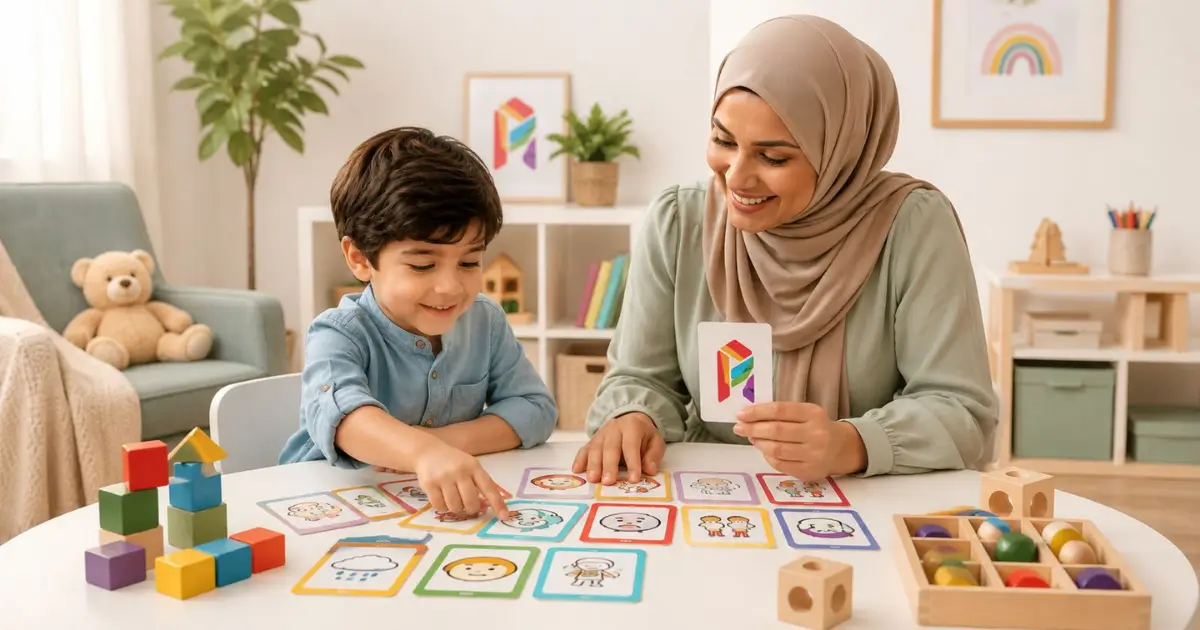
Play therapy activities for ages 3 to 6: A simple home starter to build focus, calmness, and routine
If your child is between 3 and 6 years old, you’re in a very sensitive and important stage.
This isn’t just a play stage; it’s a foundational stage: short-term focus, understanding emotions, simple waiting, daily routines, safe energy release, and bonding with your mother.
At this age you may notice that the child:
- He moves quickly from one play to another.
- He gets angry when he hears “no.”
- He refuses to switch from playing to eating or sleeping.
- He cannot sit still for long periods.
- He cries when tired or hungry.
- He doesn’t know how to express his feelings.
- He needs instructions repeated frequently.
Here you might ask:
Is this normal?
Do I need a plan?
How can I start without putting pressure on him/her?
What are some suitable play therapy activities for children aged 3 to 6 that can be done at home?
This guide gives you a clear start: short routines, simple games, and practical steps to help you develop skills without turning your home into a therapy session or creating daily stress.
A quick guide for busy moms:
At ages 3–6, we don’t start by demanding long periods of focus or complete discipline.
We start with something very simple:
Short + Fun + Consistent + Repetitive.
Start with these guidelines:
- Keep skill time to just 10 minutes.
- Use two short activities instead of one long session.
- Keep instructions to one sentence.
- Use pictures or flashcards for routines.
- Start with a safe physical activity if your child is very active.
- Teach them the names of emotions before tantrums.
- Gradually increase the time, just one minute at a time, as they succeed.
The goal isn’t for your child to “change” overnight.
The goal is to build a small, consistent daily foundation.
Why is a child’s age from 3-6 so important?
At this age, children learn more through play than from lengthy conversations.
Play helps children to:
- Attention.
- Imitation.
- Waiting.
- Understanding rules.
- Expressing feelings.
- Regulating movement.
- Building language.
- Cooperation.
- Experiencing success.
- Strengthening the bond with the mother.
Therefore, when we say “play therapy activities,” we don’t mean medical diagnosis or treatment at home.
We mean using play in a guided way to develop a child’s daily skills.
What does a child aged 3-6 really need?
1- Short Instructions
Children this age don’t benefit much from long explanations.
Instead of:
“Sweetie, you need to tidy up your toys because the room is a mess, and then we’ll eat…”
Say:
“Put the blocks in the box.”
One sentence.
One task.
Then offer clear praise.
2- Anticipated Routine
Young children love to explore what’s next, even if they sometimes resist.
A simple routine like:
A short game → A skill activity → A small reward
helps them feel secure.
3- Safe Movement
If your child is very active, don’t ask them to sit still right away.
Start with 2–3 minutes of structured movement:
A bear walk.
A bunny hop.
Pushing the wall.
A turtle crawl.
Then transition to a short, calm activity.
4- Language of Emotions
Instead of waiting for a tantrum, we train the child while they are calm.
Simple words:
Happy.
Sad.
Angry.
Scared.
Tired.
Need help.
When a child has words, they rely less on screaming and crying to express themselves.
When is behavior normal? And when do we need a clear plan?
It may be normal if:
- He gets distracted sometimes but recovers.
- He gets upset when tired or hungry.
- He sometimes resists routine.
- He needs repetition but improves.
- He can play for short periods.
We need a clearer plan if:
- Anger or distractibility is daily and severe.
- Movements trigger frequent outbursts.
- The child refuses most activities.
- They cannot follow simple instructions.
- Routines, sleep, and relationships within the home are affected.
- The mother feels stressed throughout the day.
- Daycare or school notices frequent difficulties.
In this case, we start with a structured home plan and consult a professional if necessary.
Starter routine for ages 3-6 in 7 days
Day 1: Choose a fixed time
Choose a relatively quiet time.
Not when you’re hungry, not when you’re sleepy, and not after a long screen time.
Example:
After noon.
After a snack.
Before free play time.
Start with just 10 minutes.
Day 2: Choose only two activities.
Don’t list 5 activities.
Choose:
- A 3-minute physical activity.
- A 3-minute concentration activity.
- A nice ending.
Example:
Walking animals → Color hunt → Poster or short story.
Day 3: Use 3 cards
Make 3 cards:
- We move.
- We play a skill game.
- We choose a simple gift.
All it takes is turning the child’s card.
This can be defined.
Day 4: Use a transition alert
Before you begin, say:
“Two minutes for skill time.”
Then, after two minutes:
“Now we begin.”
Don’t make the transition sudden.
Day 5: Guarantee Success
Choose a very easy activity.
The goal is for the child to feel:
“I can do it.”
Don’t choose a difficult activity at the beginning.
Day 6: Praise the specific behavior
Instead of “Good job,” say:
“I like that you sat down.”
“I like that you tried.”
“I like that you waited.”
“I like that you said ‘I’m upset’ instead of yelling.”
Day 7: Consolidate, then increase the time
If the child succeeds in 10 minutes, don’t suddenly make it 30 minutes.
Increase it by just one or two minutes.
Gradual progress is more important than excessive enthusiasm.
If you prefer a clear start rather than guesswork, begin with the free quiz.
The most suitable box or package for ages 3–6 will be recommended based on your child’s needs: focus, emotions, routine, or sensory processing.
Play Therapy Activities for Ages 3-6
Activity 1: Color Hunt
Objective: Visual focus and short-term attention
Duration: 3 minutes
Say:
“Let’s find three red objects.”
Each time they find something, put a checkmark or praise them.
Progression:
After a few days, change it to:
“Find something red and small.”
Activity 2: My Face Today
Objective: Naming Emotions
Duration: 3 minutes
Draw 3 faces:
🙂 Calm
😐 Nervous
😡 Angry
Ask him:
“Which face are you now?”
Then say:
“What does the angry face need? Breath? A hug? Water?”
Activity 3: Animal Walks
Objective: Safe energy release
Duration: 3 minutes
On a mat:
- Bear walk.
- Bunny hop.
- Tortoise crawl.
- Penguin walk.
Immediately followed by a quiet activity.
Activity 4: Listen and Do
Objective: To follow instructions
Duration: 5 minutes
Begin with one-step instructions:
“Clap.”
“Touch your head.”
“Place the cube here.”
Then, after repeating, make it two-step:
“Clap, then sit.”
Activity 5: The Box of Calm
Objective: To calm and regulate emotions
Duration: As needed
Place in a small box:
- Breathing card
- Squeeze ball
- Soft cloth
- Small book
- Emotions card
Use it during calming times first so the child doesn’t perceive it as punishment.
Common mistakes at ages 3–6
Mistake 1: Expecting a long attention span.
Children this age need a short attention span.
Don’t start with 30 minutes.
Mistake 2: Too much explanation
Talking too much confuses the child.
Use one clear sentence.
Mistake 3: Changing rules daily
Today we allow everything, and tomorrow we get angry about everything.
This confuses the child.
Consistency is more important than strictness.
Mistake 4: Starting the activity when the child is overstimulated
If the child is coming from a screen, running, or is hungry, they won’t be ready.
Begin with a calming or structured movement.
Mistake five: Trying to fix everything at once
Choose just one skill per week:
Focus.
Emotions.
Routine.
Sensory.
If your child is easily distracted or agitated, this quiz will help you choose the right start time for their age in just one minute.
When is a 3-6 year old play box helpful?
This may be suitable if your child:
- Is easily distracted.
- Is easily excitable.
- Is resistant to routine.
- I need short activities.
- I need a safe outlet for energy.
- I need to communicate my feelings.
- I need a plan ready for my parent.
- I need printed materials and cards.
This box helps because it transforms play into skill training, with clear, age-appropriate steps.
Important Professional Clarification
Play Therapy Box provides educational and behavioral support to help children develop their skills at home. It is not a medical diagnosis and is not a substitute for psychological or occupational therapy, or medical follow-up when needed.
If difficulties are severe or affect childcare, sleep, or communication, it is best to consult a qualified professional.
Summary
The best start for ages 3–6 isn’t a big plan.
The best start is 10 minutes a day:
- Safe movement.
- Skill game.
- Explicit praise.
- Illustrated routine.
- Simple repetition.
Get started now and receive your recommendation in one minute for ages 3-6.
A simple, free quiz will recommend the most suitable box or package for your child’s age and needs.
FAQ
It’s usually very short and varies from child to child. Start with 3 to 10 minutes, then gradually increase the duration based on the child’s response.
Yes, because transitioning between activities is difficult for young children. Use a three-step visual guide and a transition prompt before you begin.
Guided play is very helpful, but it’s not a substitute for professional help if the difficulties are severe or persistent.
Begin with an easy and reliable game like color hunting or animal walks, then add a simple emotions activity.
Yes, the quiz is free and will help you find the most suitable box or package for your child’s age and needs.


